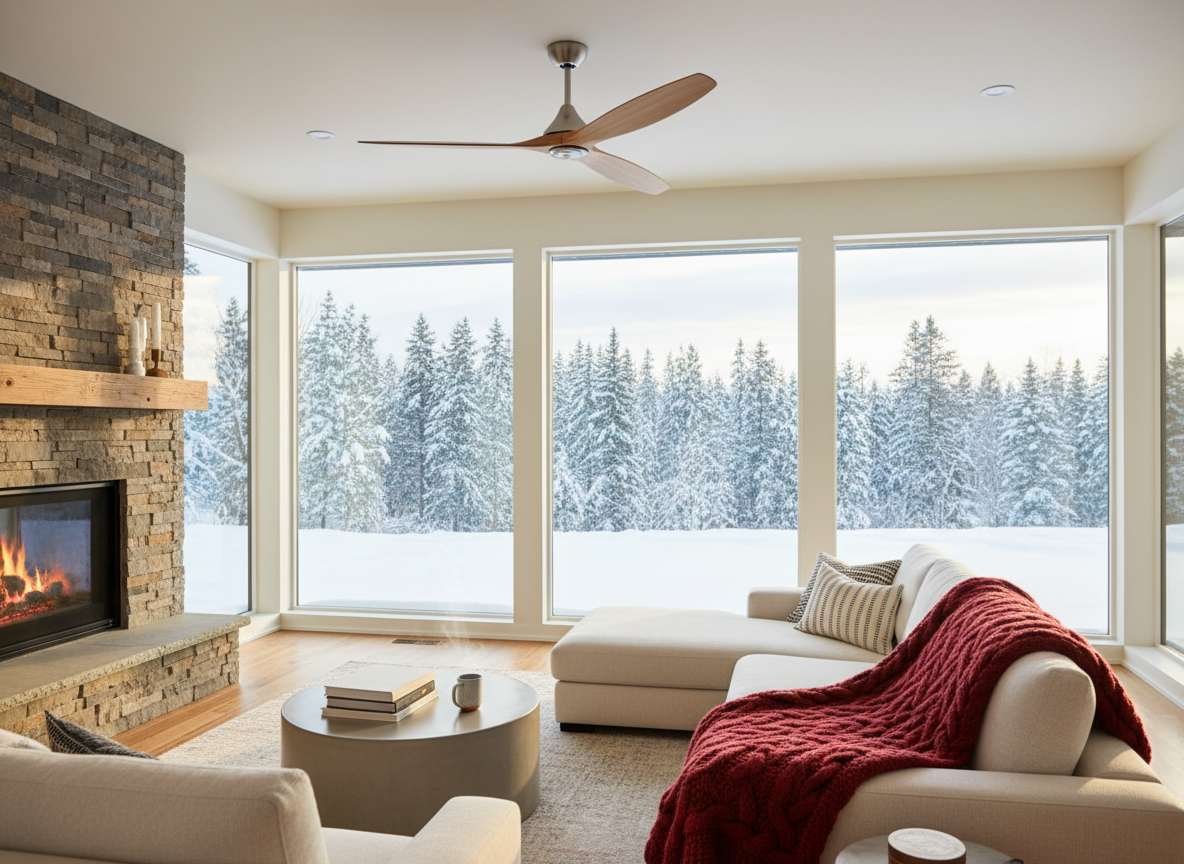
In winter, your ceiling fan should spin clockwise at low speed (as you look up at it). That gently pulls cool air up toward the ceiling and pushes the warm air that collects up there back down along the walls, without creating a chilly breeze. Both ENERGY STAR and the U.S. Department of Energy recommend this setting. Below: how to check and switch the direction, what it costs to run, and when it actually helps your heating bill.
Quick answer
| Season | Direction (looking up) | Speed | What you should feel |
|---|---|---|---|
| Winter | Clockwise | Low | Little or no breeze; room feels more evenly warm |
| Summer | Counterclockwise | Medium–high | A cooling breeze straight down |
| Room empty | Off | — | Fans cool (or mix air for) people, not rooms |
Some manufacturers label the switch differently, so always confirm with the “feel test” below.
Why clockwise works in winter
Warm air is lighter than cool air, so it rises. In many homes — especially those with high, vaulted or cathedral ceilings — the air near the ceiling can be noticeably warmer than the air where you’re sitting. Your thermostat, mounted at wall height, sees the cooler air and keeps calling for heat.
When the fan spins clockwise on low:
- The blades draw air upward in the middle of the room.
- That air spreads across the ceiling and pushes the warm layer outward and down the walls.
- Warmer air reaches the living area without blowing directly on anyone.
The U.S. Department of Energy describes it this way: reverse the fan to operate clockwise on a low speed “to move warm air from the ceiling to the living levels.”
Key takeaway: the goal in winter is gentle mixing, not a breeze. If you feel a draft, the fan is too fast or spinning the wrong way.
How to check your fan’s direction
The feel test (works on any fan)
- Turn the fan on at low or medium speed.
- Stand directly underneath it.
- Feel a strong downward breeze? It’s in summer mode (counterclockwise).
- Feel very little air, or air moving up? It’s in winter mode (clockwise).
The look test
Stand under the fan and watch the blades from below. In winter mode, the leading edge of each blade moves in the direction clock hands turn.
How to change ceiling fan direction
Always turn the fan off and let it stop completely before switching direction.
- Switch on the motor housing: Most reversible fans have a small slide switch on the body just above the blades. Flip it to the other position.
- Remote control: Many newer fans have a reverse button on the remote (often labeled with arrows or a “season” symbol).
- Wall control or app: Some DC-motor and smart fans only reverse through the wall panel or a phone app.
If you can’t find a switch, check the model number on the motor housing and look up the manual. Some older or cheaper fans simply aren’t reversible — in that case, running on low in the normal direction will create a draft and isn’t worth it in winter.
What does it cost to run a ceiling fan?
Ceiling fans use very little electricity, especially on low. Power use varies by model and motor type; a common way to estimate is to check the wattage on the label or in the manual.
Using a 30 W example on low speed and about $0.18/kWh — roughly the US average residential price in mid-2026 according to the U.S. EIA:
- 30 W × 8 hours = 240 Wh = 0.24 kWh
- 0.24 kWh × $0.18 = about $0.04 per day
- × 30 days = about $1.30 per month
| Fan wattage (on low) | Hours/day | Cost per day | Cost per month |
|---|---|---|---|
| 15 W (efficient DC motor) | 8 | $0.02 | ~$0.65 |
| 30 W | 8 | $0.04 | ~$1.30 |
| 60 W (older AC motor) | 8 | $0.09 | ~$2.60 |
If your fan has a built-in light with incandescent bulbs, the light may use far more power than the motor — swapping to LEDs is an easy win. See LED vs incandescent bulb savings for the math.
Does reversing your fan actually save money?
Honestly: it depends on your room. Nobody can promise a fixed percentage, because savings vary by ceiling height, insulation, heating system and how you set your thermostat.
It’s most likely to help when: – Ceilings are high or vaulted, so a lot of warm air collects up top – You have a wood stove, fireplace insert or a single heat source warming one area – The room has a loft or open staircase where heat pools – Warm air from forced-air vents rises straight to the ceiling
It helps less when: – Ceilings are standard 8-foot height with good insulation – You use radiant floor heating (heat already starts at floor level) – The fan runs in an empty room — the fan’s electricity is wasted
The real savings come from what you do next: if the room feels warmer at the same setting, turn your thermostat down a degree or two. ENERGY STAR notes you should adjust your thermostat when using ceiling fans to realize additional energy and dollar savings. Running a fan while leaving the thermostat unchanged can simply add a small electricity cost. Pair this with a programmable schedule — our guide to smart thermostat savings explains how.
Getting the most from your fan
- Keep it on low. Medium or high speed in winter creates a wind-chill effect that makes you feel colder.
- Turn it off when you leave. The DOE and ENERGY STAR both advise switching fans off in empty rooms.
- Check the mounting height. According to the DOE, fans work best when blades are 7 to 9 feet above the floor and 10 to 12 inches below the ceiling. On very tall ceilings, a downrod helps.
- Match fan size to the room. The DOE says a 36- or 44-inch fan suits rooms up to about 225 square feet; use 52 inches or more in larger rooms.
- Dust the blades. Heavy dust adds drag and noise; wipe them at the start of each season.
- Fix the bigger leaks first. A fan can redistribute heat, but it can’t stop it escaping. Sealing drafts and adding attic insulation usually matters far more — start with home insulation: where to start and our full guide on how to save on heating this winter.
Don’t forget to switch back in summer
When the weather warms up, flip the fan back to counterclockwise and run it faster to feel a cooling breeze. According to the DOE, a ceiling fan lets you raise your thermostat setting about 4°F (about 2°C) with no reduction in comfort in warm weather — as long as you’re in the room to feel it.
Frequently Asked Questions
Which way should a ceiling fan turn in winter?
Clockwise, when viewed from below, on low speed. This pulls air up and pushes warm air from the ceiling down along the walls without creating a draft.
Should I run my ceiling fan all winter?
Only in rooms you’re using, and mainly if warm air collects near the ceiling. Turn it off when the room is empty, since fans don’t warm the space by themselves.
Why do I feel colder with the fan on in winter?
The fan is probably spinning counterclockwise or running too fast. Moving air across your skin feels cooler. Switch to clockwise and the lowest speed.
Does ceiling fan direction matter with low ceilings?
Less so. With standard 8-foot ceilings there’s less warm air trapped up high, so the benefit is smaller. Many people with low ceilings simply leave the fan off in winter.
Is it bad to switch direction while the fan is running?
Yes — always turn the fan off and wait for the blades to stop before flipping the switch, to avoid stressing the motor.
The bottom line
For winter, set your ceiling fan to clockwise on low, run it only when you’re in the room, and turn your thermostat down slightly if the space feels warmer. It costs just pennies a day and works best in rooms with high ceilings or a single heat source. It’s a small tweak rather than a big fix — savings vary by climate, home and rates — but combined with sealing drafts and smart thermostat settings, it’s an easy, no-cost habit worth adopting.
Figures in this guide are estimates based on typical US prices at the time of writing. Savings vary by home, climate and utility rates — check your own bill before making a purchase.
