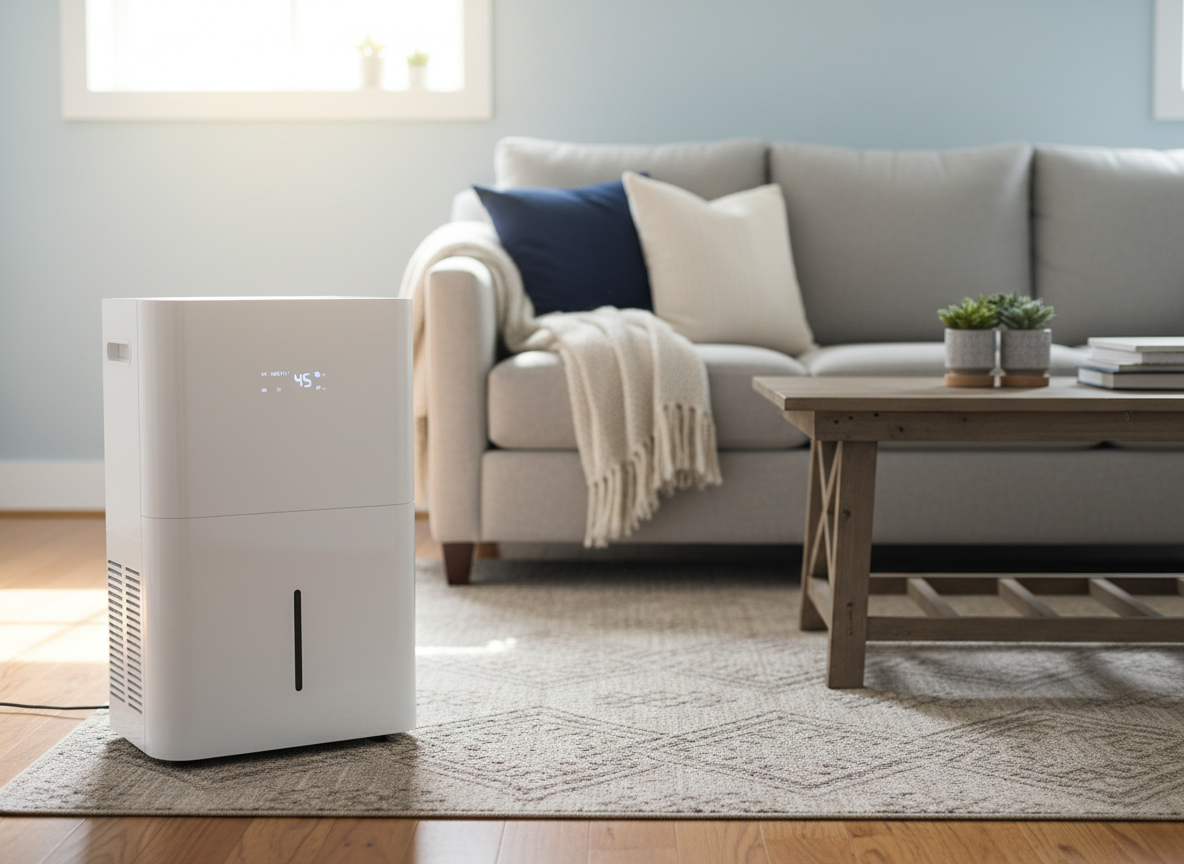
A typical portable dehumidifier costs roughly $0.40 to $1.10 a day to run at U.S. average electricity prices — about $13 to $33 a month — depending on its wattage and how many hours the compressor actually runs. A large unit running around the clock in a very damp basement can cost two to three times that. The good news: with the right humidity setting and a tight room, most households can land at the low end.
Quick answer
All figures use about $0.18 per kWh, close to the 2026 U.S. average residential electricity price reported by the U.S. EIA (18.3¢/kWh in July 2026). Wattages are examples — check your unit’s label.
| Scenario | Power draw | Run time/day | kWh/day | Cost/day | Cost/month (30 days) |
|---|---|---|---|---|---|
| Small unit, mild dampness | 300 W | 8 h | 2.4 | $0.43 | $12.96 |
| Mid-size unit, damp basement | 500 W | 12 h | 6.0 | $1.08 | $32.40 |
| Large unit, working hard | 700 W | 12 h | 8.4 | $1.51 | $45.36 |
| Large unit, running nonstop | 600 W | 24 h | 14.4 | $2.59 | $77.76 |
How to calculate your dehumidifier’s running cost
You only need three numbers:
- Watts — on the label, in the manual, or measured with a plug-in energy meter.
- Hours of compressor run time per day — not hours plugged in. Once the room reaches your set humidity, the compressor shuts off and only the fan (or nothing) runs.
- Your electricity rate in dollars per kWh — on your bill (see how to read your electric bill).
Formula: watts × hours ÷ 1,000 × price per kWh = cost per day.
Example: a 500 W dehumidifier running 12 hours: 500 × 12 ÷ 1,000 = 6 kWh × $0.18 = $1.08 per day. Over a 30-day month, that’s $32.40.
If the label only shows amps
Multiply amps by 120 volts to estimate watts. A unit labeled 4.5 A draws about 540 W at full load. Real-world draw is often a bit lower than the label maximum, so a plug-in meter gives a more accurate number.
Using the efficiency rating instead
Dehumidifiers are rated by integrated energy factor (IEF) in liters of water removed per kWh — higher is better, according to ENERGY STAR. If you know roughly how much water you empty each day, you can work backward:
- 20 pints ≈ 9.5 liters of water per day
- At an IEF of 2.0 L/kWh: 9.5 ÷ 2.0 = 4.7 kWh × $0.18 = $0.85 per day
- At an IEF of 2.8 L/kWh: 9.5 ÷ 2.8 = 3.4 kWh × $0.18 = $0.61 per day
That’s why efficiency matters: same water removed, about 28% less electricity in this example.
What affects how much a dehumidifier costs to run
1. Your humidity setting
ENERGY STAR says the optimal indoor relative humidity is generally 30% to 50%; above that range, mold can grow. Setting the unit to 35% when 50% would do makes the compressor run far longer. For most basements, 45–50% is a sensible target.
2. How damp the space is
A basement with water seeping through the walls or a clothes dryer venting indoors will keep the unit running constantly. Fixing the source is usually cheaper than paying to remove the water forever.
3. Room size vs. unit capacity
ENERGY STAR’s sizing chart recommends capacity (pints per day) based on room size and how damp it is — roughly 20 to 50+ pints/day. An undersized unit may run nonstop and never reach the setpoint; an oversized one costs more upfront but cycles off sooner.
4. Temperature
Compressor dehumidifiers work best in warm spaces. In a cool basement (below about 65°F (18°C)) many units remove less water per kWh, and some go into defrost cycles. Check your manual for its operating range.
5. Air leaks
Humid outdoor air sneaking in through a leaky rim joist, basement window or open door means the unit keeps drying “new” air. Close doors and windows to the room while it runs.
6. Efficiency of the unit
ENERGY STAR certified dehumidifiers remove the same amount of moisture as a similar conventional unit while using about 20% less energy, according to ENERGY STAR.
Example of what 20% is worth: a 500 W unit running 12 hours a day uses 6 kWh/day. Twenty percent of that is 1.2 kWh × $0.18 = $0.22 a day — about $32 over a 150-day humid season.
Seasonal cost examples
Most homes don’t run a dehumidifier all year. Here’s what a humid season might cost (150 days, $0.18/kWh):
| Unit & usage | kWh/day | Season kWh | Season cost |
|---|---|---|---|
| 300 W × 8 h | 2.4 | 360 | $64.80 |
| 500 W × 12 h | 6.0 | 900 | $162.00 |
| 700 W × 12 h | 8.4 | 1,260 | $226.80 |
If you live in a humid climate and run it year-round in a basement, multiply the daily cost by 365 instead.
Dehumidifier vs. air conditioner
Air conditioners also remove moisture as they cool. In summer, if your AC is running anyway, you may need the dehumidifier less in upstairs rooms. But:
- A dehumidifier adds a little heat to the room (its compressor and fan give off warmth), so running one in an air-conditioned room makes the AC work slightly harder.
- In basements that stay cool, a dehumidifier is usually the only practical option.
- A properly sized AC dehumidifies better than an oversized one that cycles on and off quickly.
For cooling-season ideas, see how to keep your house cool without AC.
10 ways to lower your dehumidifier’s running cost
- Set 45–50% humidity, not the lowest setting.
- Use the built-in humidistat or “auto” mode instead of continuous mode.
- Close the room — doors, windows and vents to outside.
- Clean the filter regularly (often every few weeks in heavy use — check the manual). A clogged filter cuts airflow and efficiency.
- Keep it away from walls and furniture so air flows freely around it.
- Fix water sources: clean gutters, extend downspouts away from the foundation, and vent the dryer outdoors.
- Seal basement air leaks at the rim joist and around pipes.
- Use a drain hose if possible so it doesn’t stop when the bucket fills — and you don’t forget to empty it.
- Run it in a warm enough space, or pick a model rated for low temperatures.
- Replace an old, inefficient unit with an ENERGY STAR model when it’s time.
Key takeaway: the humidity setting and the dampness of the space matter more than almost anything else. Cutting run time from 12 to 8 hours on a 500 W unit saves 2 kWh a day — $0.36/day, or about $54 over a 150-day season.
For a wider look at your home’s biggest energy users, see what uses the most electricity at home.
Frequently Asked Questions
Is it expensive to run a dehumidifier all day?
It can be. A 600 W unit running 24 hours uses 14.4 kWh — about $2.59 a day at $0.18/kWh. Most units cycle off once they reach the setpoint, so actual costs are usually lower.
How many watts does a dehumidifier use?
It varies by size and model. Check the label or manual for watts (or multiply amps × 120 V). A plug-in energy meter shows the real draw.
What humidity should I set my dehumidifier to?
ENERGY STAR says 30–50% relative humidity is generally ideal, and 30–40% in colder climates during heating season to avoid window condensation. Around 45–50% is a common, economical basement setting.
Should I run my dehumidifier all the time?
Only if the space stays damp. Use auto mode so the compressor runs only when humidity rises above your target.
Is an ENERGY STAR dehumidifier worth it?
Usually yes if you run it many hours a year. ENERGY STAR says certified models use about 20% less energy than similar conventional units; the more you run it, the faster that pays back.
The bottom line
Most dehumidifiers cost somewhere between a few dollars and a few tens of dollars a month to run — the exact number is simply watts × hours × your rate. Set a sensible humidity target, keep the room closed, fix moisture at its source and choose an efficient model, and you’ll keep both the damp and the bill under control. Savings vary by climate, home and rates.
Figures in this guide are estimates based on typical US prices at the time of writing. Savings vary by home, climate and utility rates — check your own bill before making a purchase.
