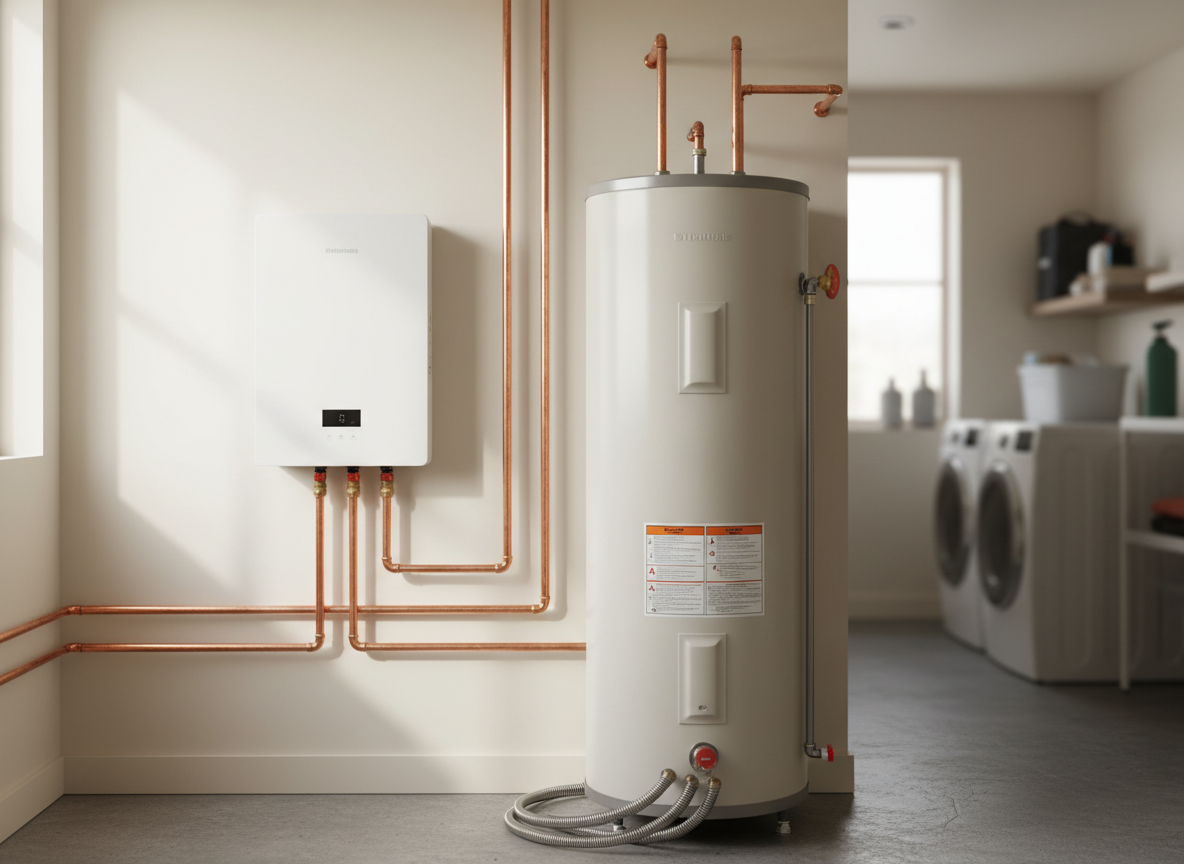
A tankless water heater usually uses less energy than a traditional tank because it doesn’t keep 40–50 gallons hot around the clock. The U.S. Department of Energy estimates tankless units are 24%–34% more energy efficient for homes that use 41 gallons or less of hot water a day. But they typically cost more to buy and install, so the payback can take many years. For many all-electric homes, a heat pump water heater saves more than either.
Quick answer
| Factor | Tank (storage) | Tankless (on-demand) |
|---|---|---|
| How it works | Keeps a tank of water hot 24/7 | Heats water only when a tap is open |
| Energy efficiency | Loses heat while standing (standby loss) | DOE: 24–34% more efficient at ≤41 gal/day; 8–14% at ~86 gal/day |
| Hot water supply | Can run out; limited by tank size | Continuous, but limited by flow rate (gallons per minute) |
| Typical lifespan | Often 10–15 years | Often 20 years or more (ENERGY STAR cites ~20 years for gas tankless) |
| Upfront cost | Lower | Higher, especially if gas lines, venting or electrical need upgrades |
| Space | Large cylinder | Small wall-mounted box |
| Best for | Tight budgets, simple like-for-like swaps | Long-term owners, small households, limited space |
Savings vary by climate, home, hot water use and rates.
How each type works
Tank (storage) water heaters
A conventional water heater holds a tank of water, typically 30–80 gallons, and keeps it at your set temperature all the time. When hot water sits in the tank, some of its heat escapes through the walls and the flue. That’s called standby loss, and you pay for it even when nobody is using water.
Tankless (on-demand) water heaters
A tankless unit sits on the wall and only fires up when you open a hot tap. Cold water flows through a heat exchanger heated by a gas burner or electric elements, and comes out hot. No tank means no standby loss, which is where most of the energy savings come from.
The catch is flow rate. A tankless heater can only heat so many gallons per minute (gpm). If you run a shower, the dishwasher and a kitchen tap at once, you can exceed its capacity and get lukewarm water. Capacity also drops in cold climates, because incoming groundwater is colder and needs a bigger temperature rise.
How much energy does tankless actually save?
The Department of Energy’s figures are the most useful benchmark:
- Homes using 41 gallons or less of hot water per day: tankless units are 24%–34% more energy efficient than conventional storage heaters.
- Homes using around 86 gallons per day: the advantage shrinks to 8%–14%.
Why does it shrink? Standby loss is roughly the same no matter how much water you use. In a big, busy household it’s a smaller share of the total, so eliminating it matters less.
ENERGY STAR puts a dollar figure on it for gas: an ENERGY STAR certified gas tankless water heater can save a family of four about $95 a year, or about $1,800 over its lifetime, compared with a standard gas storage model.
A worked example
Here’s an illustrative calculation, not a promise. Suppose your gas tank water heater uses 200 therms a year. At roughly $1.50 per therm (based on EIA’s 2025 average residential natural gas price of about $15 per thousand cubic feet):
- Current cost: 200 × $1.50 = $300 a year
- With 24% savings: $300 × 0.24 = $72 a year saved
- With 34% savings: $300 × 0.34 = $102 a year saved
Now the payback. If the tankless installation costs $1,500 more than replacing your tank like-for-like:
- $1,500 ÷ $72 ≈ 21 years
- $1,500 ÷ $102 ≈ 15 years
That’s why tankless tends to make most sense when you plan to stay in the home a long time, when the extra install cost is small, or when you value endless hot water and freed-up floor space for their own sake. Use your own gas usage and real quotes; your numbers could be much better or worse.
Upfront cost: where tankless gets expensive
Installed prices vary widely by region, brand and what your home already has, so get at least three quotes. The big cost drivers are:
- Gas line size. Gas tankless units need a lot of fuel for short bursts, and many homes need a larger gas line.
- Venting. Switching from a tank to a gas tankless unit usually means new venting.
- Electrical capacity. Whole-house electric tankless heaters draw a very large amount of power while running, often 20 kilowatts or more. Many homes would need new circuits and sometimes a panel or service upgrade.
- Water quality. In hard-water areas, manufacturers typically call for periodic descaling (flushing) of the heat exchanger, which is either a DIY job or a service call.
Tank replacements, by contrast, are usually a straightforward swap using the existing connections.
Electric homes: consider a heat pump water heater
If your water heater is electric, a heat pump water heater (HPWH) is often the stronger money-saver. Instead of heating water directly with an element, it moves heat from the surrounding air into the tank, much like a refrigerator in reverse.
ENERGY STAR estimates that a certified heat pump water heater can save a household of four about $550 a year on electricity compared with a standard electric water heater. That estimate assumes about $0.146/kWh, lower than today’s average of roughly 18 cents according to the U.S. EIA, so savings at current prices could be higher.
HPWHs do need space (usually a room with some air volume, like a garage or basement), they cool the room they’re in slightly, and they cost more upfront than a basic tank. They’re also a tank, so you can still run out of hot water in heavy use. Our guide to what uses the most electricity at home shows how big water heating is in a typical bill.
What about tax credits?
Be careful with older articles. The federal 25C Energy Efficient Home Improvement Credit, which used to cover qualifying heat pump water heaters and some gas water heaters, ended for property placed in service after December 31, 2025, under the 2025 federal budget law. You can’t claim it for a water heater installed in 2026.
That doesn’t mean there’s no help at all. Check with your utility and state energy office; some offer rebates for efficient water heaters. Program availability changes often, so confirm before you buy.
Which one should you choose?
A tank water heater makes sense if:
- Your budget is tight and your current tank just failed.
- You have a larger household with high, overlapping hot water demand.
- Your gas line, venting or electrical panel would need expensive upgrades for tankless.
A tankless water heater makes sense if:
- You’re staying in the home long term, so the longer lifespan pays off.
- Your household uses a moderate amount of hot water (where DOE’s 24–34% range applies).
- You want continuous hot water for back-to-back showers, or you need the floor space.
- Your home already has adequate gas supply and venting access.
A heat pump water heater makes sense if:
- You currently have an electric tank and have room for the unit.
- You want the largest energy savings on an electric water heater.
Easy savings whatever you choose
- Set the temperature to 120°F (49°C) unless your manufacturer or a household health need calls for otherwise. Higher settings waste energy and raise scald risk.
- Fix dripping hot taps; you pay to heat every drop.
- Use efficient showerheads and wash clothes in cold water where it works.
- Insulate accessible hot water pipes to reduce heat loss on the way to the tap.
- If you’re on a time-of-use electric plan, a tank or HPWH with a timer can heat water during cheaper hours.
For a wider look at where your home is wasting energy, try a DIY home energy audit.
Frequently Asked Questions
Do tankless water heaters really save money?
They save energy by removing standby loss. DOE estimates 24–34% better efficiency for homes using 41 gallons a day or less. Whether that turns into net savings depends on how much more you pay upfront and how long you stay in the home.
Can a tankless water heater run out of hot water?
It won’t run out the way a tank does, but it can be overwhelmed. If you use more hot water at once than its gallons-per-minute rating, the water will be cooler. Proper sizing avoids this.
How long does each type last?
Tank heaters often last around 10–15 years. ENERGY STAR cites a life expectancy of about 20 years for gas tankless units. Maintenance and water quality affect both.
Is electric tankless a good idea?
It can work well for small homes or single points of use, but whole-house electric tankless units draw very high power and may require electrical upgrades. For an electric home, a heat pump water heater is often the bigger saver.
Can I still get a federal tax credit for a new water heater?
Not the 25C credit. It ended for property placed in service after December 31, 2025. Check your utility and state for current rebates.
The bottom line
Tankless water heaters use less energy, last longer and never leave you with a cold tank, but the higher installation cost means payback can take well over a decade. They shine for long-term owners with moderate hot water use and a home that doesn’t need major gas or electrical upgrades. If your water heater is electric, compare a heat pump water heater before anything else. Get multiple quotes, run the math with your own usage, and remember that savings vary by climate, home and rates.
Figures in this guide are estimates based on typical US prices at the time of writing. Savings vary by home, climate and utility rates — check your own bill before making a purchase.
