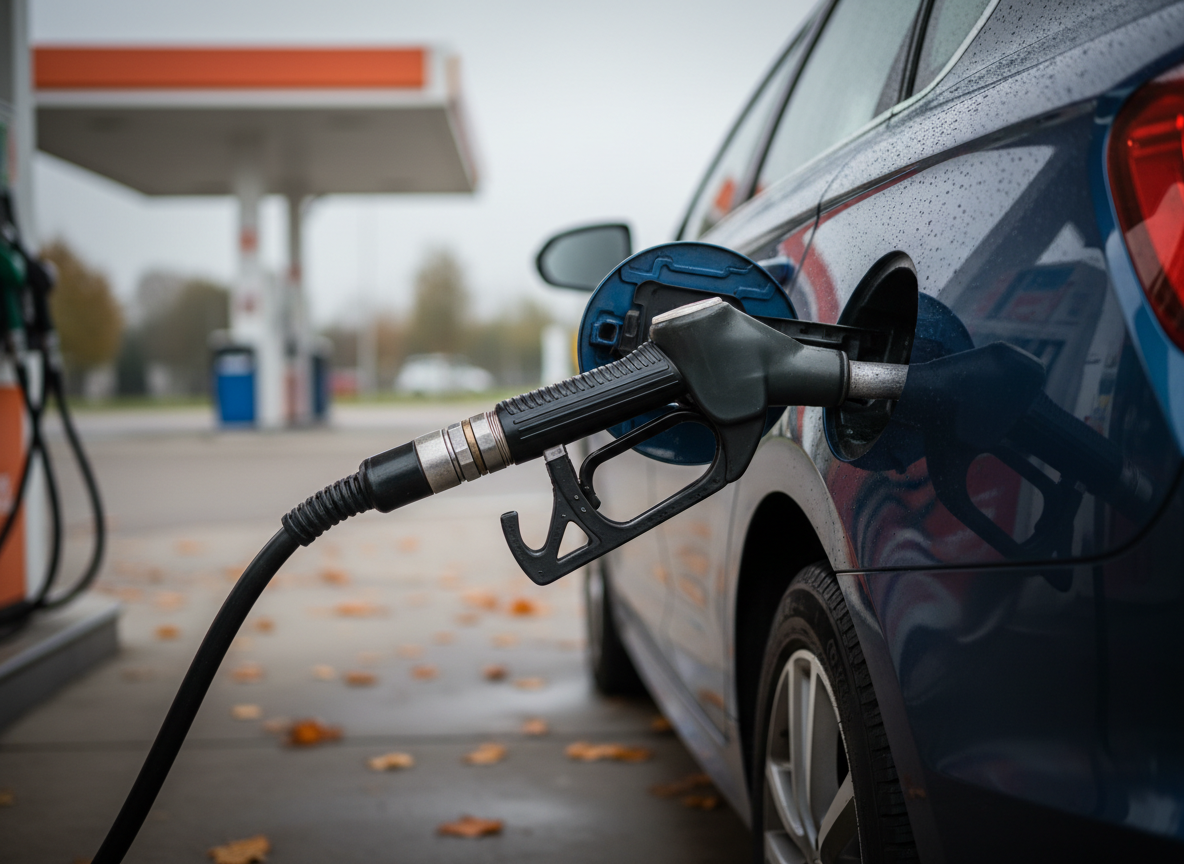
US gasoline prices have started to slip after the most expensive September on record, but drivers are still paying well over a dollar a gallon more than a year ago. Here is what the latest figures show and what they mean for a typical household fuel budget.
Key takeaways
- AAA’s national average for regular gasoline fell to about $4.38 a gallon on October 3, down roughly 7 cents in a week.
- September averaged $4.33 a gallon, according to AAA, 50 cents above the previous September record set in 2023.
- For a driver using 40 gallons a month, today’s price still means roughly $49 more per month than a year ago.
What happened
In its October 1 update, AAA reported a national average of $4.41 for a gallon of regular, down nearly 7 cents from $4.48 a week earlier. By Saturday, October 3, AAA’s daily figure had eased further to $4.38. The decline follows a month in which pump prices set a seasonal record: AAA said September’s average of $4.33 was 50 cents higher than the previous September high of $3.83, recorded in 2023.
Government data point in the same direction, though with a lag. The US Energy Information Administration (EIA), which surveys retail prices every Monday, put regular gasoline at $4.47 a gallon on September 28, down about 1 cent from the prior week and roughly $1.35 above the same week of 2025. The EIA’s figure for diesel was $6.38, down nearly 15 cents in a week but about $2.63 higher than a year earlier.
AAA linked part of the easing to softer demand. Citing EIA data, it said gasoline demand fell from 8.84 million to 8.68 million barrels a day, which is typical as summer driving fades. Crude oil, however, has not fallen: West Texas Intermediate rose $1.04 to $90.42 a barrel on September 30. The wider backdrop is the disruption to tanker traffic through the Strait of Hormuz, which we covered in our report on oil nearing $100.
Prices also vary widely by state. AAA’s October 1 data showed California the most expensive at $6.40 a gallon, followed by Hawaii ($5.62), Washington and Nevada ($5.49 each) and Oregon ($5.05). The cheapest were Indiana ($3.81), Texas ($3.94), Georgia and Mississippi ($3.96 each) and Louisiana ($3.97). The EIA’s regional numbers show the same pattern, with the West Coast averaging $5.72 and the Gulf Coast $3.92 on September 28.
Looking further ahead, the EIA’s September Short-Term Energy Outlook forecast that gasoline will average $3.84 a gallon across 2026 and fall to $3.35 in 2027, assuming flows through Hormuz gradually recover. The agency also said export constraints in the Middle East are likely to persist through the end of this year. Its next outlook is due on October 6.
What it means for your bill
A 7-cent weekly drop is welcome, but small next to the rise over the past year. Take a household that drives 12,000 miles a year in a car averaging 25 miles per gallon. That works out to 1,000 miles and 40 gallons a month.
- Today: 40 gallons × $4.38 = $175.20 a month.
- A year ago: 40 gallons × $3.16 = $126.40 a month.
- Difference: about $48.80 more each month, or roughly $585 over a full year at current prices.
- Last week’s dip: 40 gallons × $0.07 = about $2.80 saved per month.
Where you live matters just as much. The same 40 gallons cost about $256 a month at California’s $6.40 average, compared with about $152 in Indiana at $3.81, a gap of more than $100 a month for identical driving. Filling a 15-gallon tank at the national average now costs about $65.70, versus roughly $47.40 a year ago.
Diesel prices matter even to households that never buy it. Diesel powers the trucks that deliver food and goods, and it is closely related to the heating oil used in many Northeast homes, so diesel at more than $6 a gallon is a warning sign for winter heating budgets.
For electric-vehicle owners, AAA put the national average for public charging at 42 cents per kilowatt-hour, unchanged on the week. As an illustration, an EV that travels about 3.5 miles per kWh would need roughly 286 kWh for 1,000 miles, or about $120 at that public rate, and usually far less when charged at home. Our guide to EV charging costs at home shows how to run the numbers for your own utility rate.
What you can do
- Compare local prices before filling up. Prices can differ by tens of cents between stations in the same area. On a 15-gallon fill, a 20-cent difference saves $3.
- Check your tire pressure. Under-inflated tires increase rolling resistance and fuel use. Use the pressure printed on the driver’s door frame, not the tire sidewall.
- Combine errands and ease off the accelerator. Short cold-engine trips and hard acceleration both use more fuel per mile. Grouping errands into one trip helps.
- Plan for winter heating now. If you heat with oil or propane, ask your supplier about budget plans or pre-buy options, and see our 15 practical tips to save on heating.
Sources
- AAA, “National Average Dips Following Record-Setting September”, October 1, 2026
- AAA Gas Prices, daily national average, October 3, 2026
- US Energy Information Administration, Gasoline and Diesel Fuel Update, data for September 28, 2026
- US Energy Information Administration, Short-Term Energy Outlook, September 9, 2026
- Clarksville Online, “National Gas Price Average Drops Nearly 7 Cents After Record September”, October 3, 2026
Written by The Daily Economy editorial team with AI assistance and checked against the sources above. Read our editorial policy.