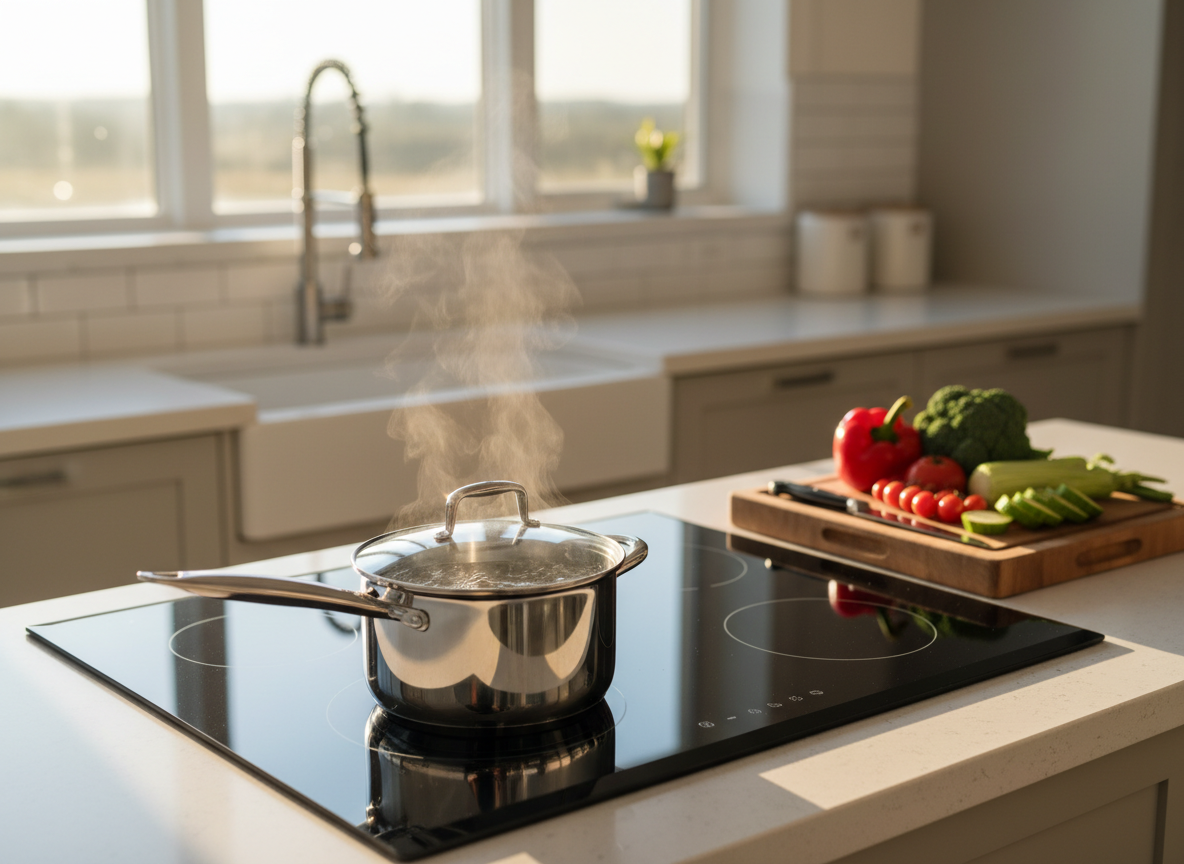
Switching to an induction cooktop saves real energy, but usually not much money. Induction is the most efficient way to cook — about 85% of the energy reaches the pan — yet at U.S. average prices it saves only around $5–$20 a year compared with an electric coil or smooth-top, and it typically costs a bit more to run than gas. Where induction can pay off is when it lets you drop a gas account entirely, when your old stove needs replacing anyway, or when electricity in your area is cheap.
Quick answer
| Switching from… | Yearly running-cost change (example home) | Pays back on energy alone? |
|---|---|---|
| Electric coil / smooth-top → induction | Save ~$9/year | No — decades at typical prices |
| Gas stove → induction (still using gas for heat) | Pay ~$20/year more | No |
| Gas stove → induction, closing the gas account | Save ~$160/year (if fixed charge is $15/month) | Possibly, in roughly 5–10 years |
| Adding a portable induction burner | Small either way | Not about savings — a low-cost way to try induction |
Example household cooks the equivalent of 1.5 kWh a day on a conventional electric element, at about $0.18/kWh for electricity and $1.55/therm for gas. Your numbers will differ — the math is shown below so you can plug in your own rates.
How induction saves energy
An induction cooktop uses a magnetic field to heat the pan itself, instead of heating a coil, glass or flame that then heats the pan. Less heat escapes into the kitchen. ENERGY STAR puts typical cooktop efficiency at:
- Induction: about 85%
- Electric resistance (coil and radiant smooth-top): about 75–80%
- Gas: about 32%
ENERGY STAR describes induction as about 5–10% more efficient than conventional electric cooktops and about three times as efficient as gas. That sounds big — and in energy terms, it is. But the dollars depend on two things: how much energy cooking uses in the first place, and what you pay for electricity and gas.
The prices behind the math
- Electricity: about $0.18 per kWh. The U.S. EIA’s October 2026 Short-Term Energy Outlook puts the 2026 average residential electricity price at about 18.2¢ per kWh.
- Natural gas: about $1.55 per therm. The same EIA outlook forecasts a 2026 average residential gas price of about $16.09 per thousand cubic feet (Mcf). One Mcf holds roughly 10.37 therms, so $16.09 ÷ 10.37 ≈ $1.55 per therm.
Local rates vary widely, so check your own bill — our guide on how to read your electric bill shows where to find your real price per kWh.
Induction vs. electric coil or smooth-top
This is the most common upgrade, and the one with the smallest savings.
Take a household whose stovetop cooking uses 1.5 kWh a day on a conventional element — for example, a 1,500-watt burner running for an hour, or a larger burner for less time.
- Coil / smooth-top: 1.5 kWh × 365 days = 547.5 kWh × $0.18 = $98.55 a year
- Induction (same heat into the food): 547.5 kWh × (0.775 ÷ 0.85) ≈ 499 kWh × $0.18 = $89.86 a year
- Savings: about $8.70 a year
Double the cooking (3 kWh a day) and the savings roughly double to about $17 a year. Even at a high rate of $0.30/kWh, the example home saves only about $14.50 a year ($164.25 vs. $149.76).
What about payback?
Induction ranges typically cost more than comparable radiant smooth-top ranges. If the induction model costs, say, $500 more, then $500 ÷ $9 a year ≈ 55 years to earn it back through electricity savings. In other words, energy savings alone won’t justify replacing a working electric stove.
If your old range has died and you’re buying new anyway, the question changes: you’re only weighing the price difference between models, and you’re getting the other benefits below as well.
Induction vs. gas
Here’s where many people are surprised. Gas cooktops waste most of their heat, but gas energy is much cheaper per unit than electricity, so the two effects roughly cancel out.
Using the same example household (the same heat delivered to the food):
- Useful heat per day: 1.5 kWh × 77.5% × 3,412 BTU/kWh ≈ 3,966 BTU
- Gas needed: 3,966 ÷ 0.32 ≈ 12,395 BTU a day = 0.124 therm
- Per year: 0.124 × 365 ≈ 45.2 therms × $1.55 = about $70 a year
- Induction: about $90 a year
So at average U.S. prices, induction costs roughly $20 a year more to run than gas for this home. For a side-by-side of all three stove types, see our gas vs electric stove cost guide.
When induction beats gas on running costs
Divide the yearly gas cost by induction’s yearly kWh: $70.13 ÷ 499 kWh ≈ 14¢ per kWh. If you pay less than about 14¢ per kWh for electricity (with gas at $1.55/therm), induction is cheaper to run than gas. If your gas is pricier than average, that break-even point rises.
| Electricity price | Gas price | Coil / smooth-top | Induction | Gas |
|---|---|---|---|---|
| $0.13/kWh | $1.55/therm | $71 | $65 | $70 |
| $0.18/kWh | $1.55/therm | $99 | $90 | $70 |
| $0.30/kWh | $1.55/therm | $164 | $150 | $70 |
If you’re on time-of-use rates, cooking outside peak hours can lower the effective electricity price and tip the balance.
The big one: dropping your gas account
If your stove is the only gas appliance in your home, the energy used for cooking is not the main cost — the gas bill’s fixed monthly customer charge is. You pay it whether you cook or not.
Suppose that charge is $15 a month (check your own bill — it varies a lot by utility):
- Fixed charge avoided: $15 × 12 = $180 a year
- Gas for cooking avoided: +$70
- Extra electricity for induction: −$90
- Net savings: about $160 a year
If the switch costs $1,500 all-in (range plus some electrical work), simple payback is about $1,500 ÷ $160 ≈ 9 years. A cheaper range, no electrical work, or a higher fixed charge shortens that; a panel upgrade lengthens it a lot.
Key takeaway: if gas also heats your home or water, this saving doesn’t apply — the fixed charge stays.
Upfront costs to plan for
- The cooktop or range. Induction ranges often start around $1,000 and premium models cost well over $2,000. Portable single-burner induction plates are far cheaper, often under $150.
- Cookware. Induction only works with magnetic pans. Cast iron and many stainless steel pans work; plain aluminum, copper and glass usually don’t unless labeled induction-ready. Test with a fridge magnet — if it sticks firmly to the base, the pan will work.
- Wiring. Full-size induction ranges usually need a 240-volt circuit. If you’re replacing an electric range, that circuit is normally already there. Coming from gas, you may need an electrician, and possibly a panel upgrade if your service is already maxed out. A few battery-assisted induction ranges that plug into a standard 120-volt outlet have come to market, but they cost more.
- Removing gas. Capping the gas line should be done by a qualified professional.
Rebates and tax credits
There is no federal tax credit for buying a stove. The Home Electrification and Appliance Rebates (HEAR) program, funded by the Inflation Reduction Act and run by the states, offers up to $840 toward an electric or induction stove — but only for low- and moderate-income households, and only in states whose programs are open. Some states have paused or delayed their programs, so check your state energy office and your utility before you buy.
Benefits that aren’t on the bill
Not every reason to choose induction shows up as dollars:
- Speed: induction heats pans quickly — boiling water is noticeably faster than on a coil.
- Control: it responds instantly to changes, much like gas.
- Cooler kitchen: less waste heat escapes, which can help a little in summer when your AC is running.
- Easy cleaning: the glass surface doesn’t get as hot as a radiant top, so spills burn on less.
- No combustion indoors: gas stoves release combustion byproducts. Whatever you cook on, use a range hood vented outdoors.
Cheaper ways to cut cooking costs
If you want lower cooking bills without buying a new range:
- Use lids — water boils faster and simmering takes less power.
- Match pan to burner size so heat doesn’t spill around the edges.
- Use small appliances — a microwave, electric kettle or air fryer often uses less energy than a full oven for small meals.
- Try a portable induction plate for everyday tasks like boiling water, to see if you like induction before committing.
Cooking is a small slice of most homes’ energy use; heating, cooling and water heating are much bigger. See what uses the most electricity at home to find bigger savings.
Frequently Asked Questions
How much money does an induction cooktop save?
Compared with an electric coil or smooth-top, typically around $5–$20 a year at U.S. average prices, depending on how much you cook. Compared with gas, induction usually costs a little more to run unless your electricity is cheap.
Is induction cheaper to run than gas?
Only where electricity is cheap relative to gas. With gas at about $1.55 per therm, induction is cheaper below roughly 14¢ per kWh. At the 2026 U.S. average of about 18¢, gas is slightly cheaper to run.
Is it worth replacing a working stove with induction?
Not for energy savings alone — payback can take decades. It can make financial sense if the stove is your only gas appliance and you can close the gas account, or if your current stove needs replacing anyway.
Do I need new pots and pans for induction?
Only if they aren’t magnetic. If a magnet sticks firmly to the bottom of a pan, it will work on induction. Cast iron and most magnetic stainless steel are fine.
Are there rebates for induction stoves?
The state-run HEAR program offers up to $840 for income-qualified households where programs are open. There’s no federal tax credit. Check your state energy office and utility for current offers.
The bottom line
Induction cooktop savings are real but small: about $9 a year versus a conventional electric stove in our example, and usually a slightly higher running cost than gas at average U.S. prices. The money case is strongest when induction lets you close a gas account, when you’re replacing a stove anyway, or when your electricity is cheap. Otherwise, choose induction for speed, control and a cleaner kitchen — and expect savings to vary by home, cooking habits and rates.
Sources: U.S. Energy Information Administration, Short-Term Energy Outlook (October 2026); ENERGY STAR, Residential Induction Cooking Tops; Rewiring America, Home Electrification and Appliance Rebates.
Figures in this guide are estimates based on typical US prices at the time of writing. Savings vary by home, climate and utility rates — check your own bill before making a purchase.
Written by The Daily Economy editorial team with AI assistance and checked against the sources above. Read our editorial policy.