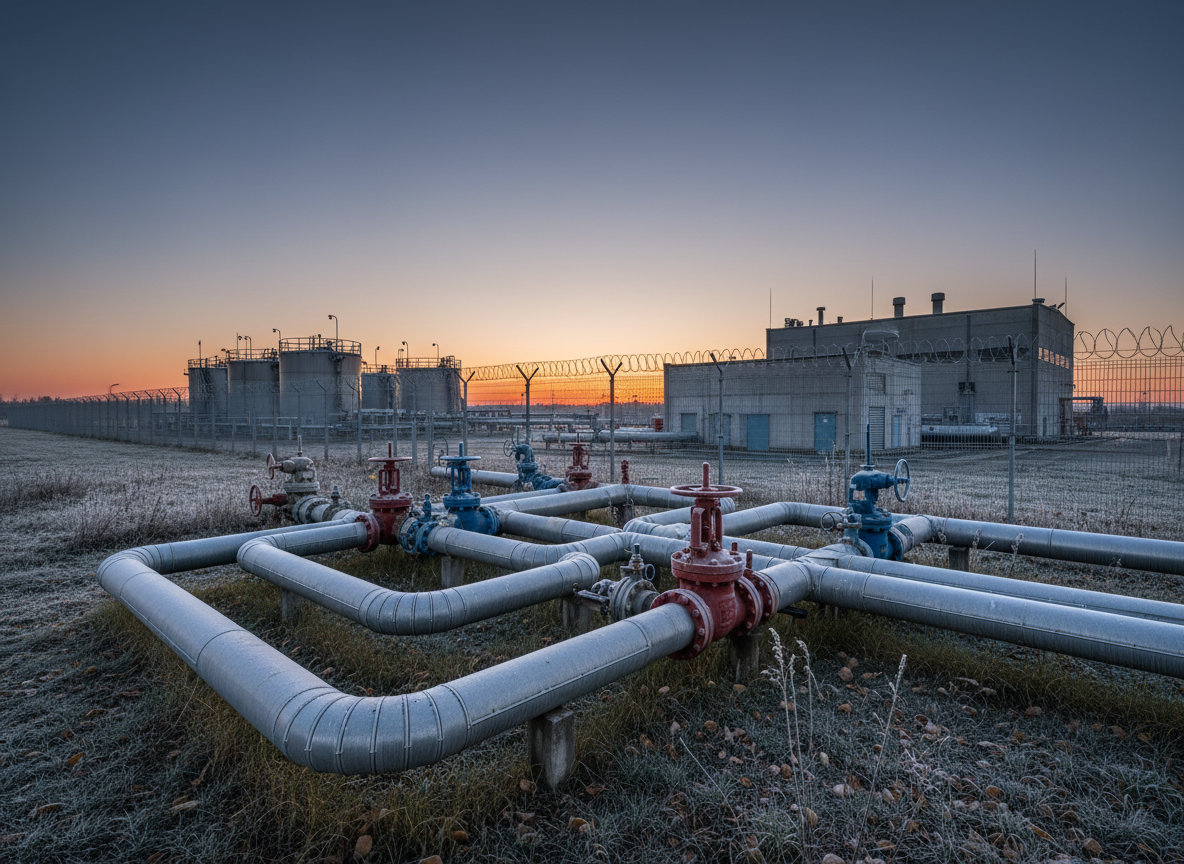
Europe enters the heating season with its gas storage sites about 73% full, roughly ten points below last year, and the network operators’ official winter outlook warns that stocks could fall “well below 30%” by March if liquefied natural gas (LNG) deliveries stay tight. Wholesale gas prices rose for a second straight week in response.
Key takeaways
- EU gas storage stood at about 73% on 9 October, versus about 83% a year earlier, according to Gas Infrastructure Europe data cited by Anadolu Agency.
- The European gas network body ENTSOG and the European Commission say supply should cover demand this winter, but stocks could end the season very low if LNG stays scarce.
- The Dutch TTF benchmark climbed to about €79 per megawatt-hour (about $89) on 9 October. Household bills react with a delay, but a sustained rise feeds into winter and 2027 tariffs.
What happened
On 8 October, ENTSOG, the association of Europe’s gas transmission system operators, published its Winter Supply Outlook for October 2026 to March 2027. It found that EU underground storage was 72% full on 1 October after what it called a challenging injection season. Storage matters because it covered about 26% of EU gas consumption last winter and about 30% the winter before.
The report’s main warning is about the end of winter rather than the start. If LNG availability remains limited, ENTSOG says storage could fall well below 30% by the end of March. That would leave Europe more exposed to late cold spells and make refilling next summer harder. On the positive side, the EU can import about 1,600 terawatt-hours of LNG over a winter season, which can partly offset the lower starting stocks.
The same day, the Commission’s Gas Coordination Group reviewed the findings and concluded that “the EU gas system is sufficiently flexible to meet demand this winter.” The Commission said the situation “differs significantly” from the 2021–2022 crisis because supply is more diversified, LNG import capacity is higher and demand is lower. It added that it will monitor storage, supply and prices closely through the winter.
Markets were less relaxed. The front-month TTF contract, Europe’s reference wholesale gas price, closed the previous week at €74.76/MWh and rose about 5.6% to roughly €78.9/MWh on 9 October, a three-week high. Traders pointed to tanker attacks near the Strait of Hormuz, which carries around a fifth of global LNG trade, forecasts of colder weather in north-western Europe, and unplanned outages at Norwegian gas fields. Prices eased slightly after US President Donald Trump said the US would not resume strikes on Iran before November’s midterm elections.
For context, Euronews reported in late September that TTF was about €40/MWh higher than before the US and Israeli strikes on Iran on 28 February. In a letter to member states, Energy Commissioner Dan Jørgensen urged voluntary steps to cut gas and peak-time electricity use and suggested aiming for an 80% storage level rather than paying any price to reach 90%.
What it means for your bill
Most European households do not pay the wholesale price directly. Suppliers buy gas months ahead, and regulated tariffs in countries such as France and Spain are reset on a fixed schedule, so wholesale moves reach bills with a lag of weeks to months. Taxes, network charges and national support schemes also differ widely, which is why the same wholesale shock produces very different bills in, say, Germany and Italy.
Still, the arithmetic shows what is at stake. Eurostat puts the average EU household gas price at €0.1228/kWh (about $0.14) including taxes for the second half of 2025, before this year’s price shock. Take a household that uses 10,000 kWh of gas a year, a round figure for illustration (actual use varies a lot by climate and home size):
- Baseline: 10,000 kWh × €0.1228 = €1,228 a year (about $1,380).
- This week’s move: +€4.15/MWh = +€0.00415/kWh. If sustained and fully passed on: 10,000 × €0.00415 = about €42 a year (about $47), before VAT.
- The rise since February: about +€40/MWh = +€0.04/kWh. Fully passed on: 10,000 × €0.04 = €400 a year (about $450). With VAT at 20%, closer to €480 (about $540), an increase of roughly a third on the baseline bill.
Pass-through is rarely complete or immediate, and some governments are cushioning bills. But the outlook matters for the months ahead: if storage ends winter very low, Europe will have to buy a lot of gas next summer, which can keep wholesale prices, and therefore 2027 tariffs, elevated. Gas also sets the electricity price in many hours, so power bills are exposed too.
What you can do
- Check your contract type. If you are on a variable or regulated tariff, find out when it next resets. If a supplier offers a fixed price, compare it with your current rate before signing; fixed deals now may already include the higher prices.
- Turn the thermostat down a little. Each degree lower typically trims heating use noticeably. Our guide on how to save on heating this winter has 15 practical steps.
- Seal drafts before the cold arrives. Weatherstripping doors and windows is cheap and quick; see our weatherstripping guide.
- Shift electricity use away from peak hours if you have a time-of-use tariff. That is exactly what the Commission is asking for, and it can cut your bill.
Sources
- ENTSOG: Winter Supply Outlook 2026/27 press release (8 October 2026)
- European Commission: EU gas system prepared for the winter despite lower storage levels (8 October 2026)
- Anadolu Agency: European gas prices set for weekly rise (9 October 2026)
- Prestige Business Solutions: Energy market report (9 October 2026)
- Euronews: EU tells countries to curb energy demand (27 September 2026)
- Eurostat: Natural gas price statistics
Written by The Daily Economy editorial team with AI assistance and checked against the sources above. Read our editorial policy.