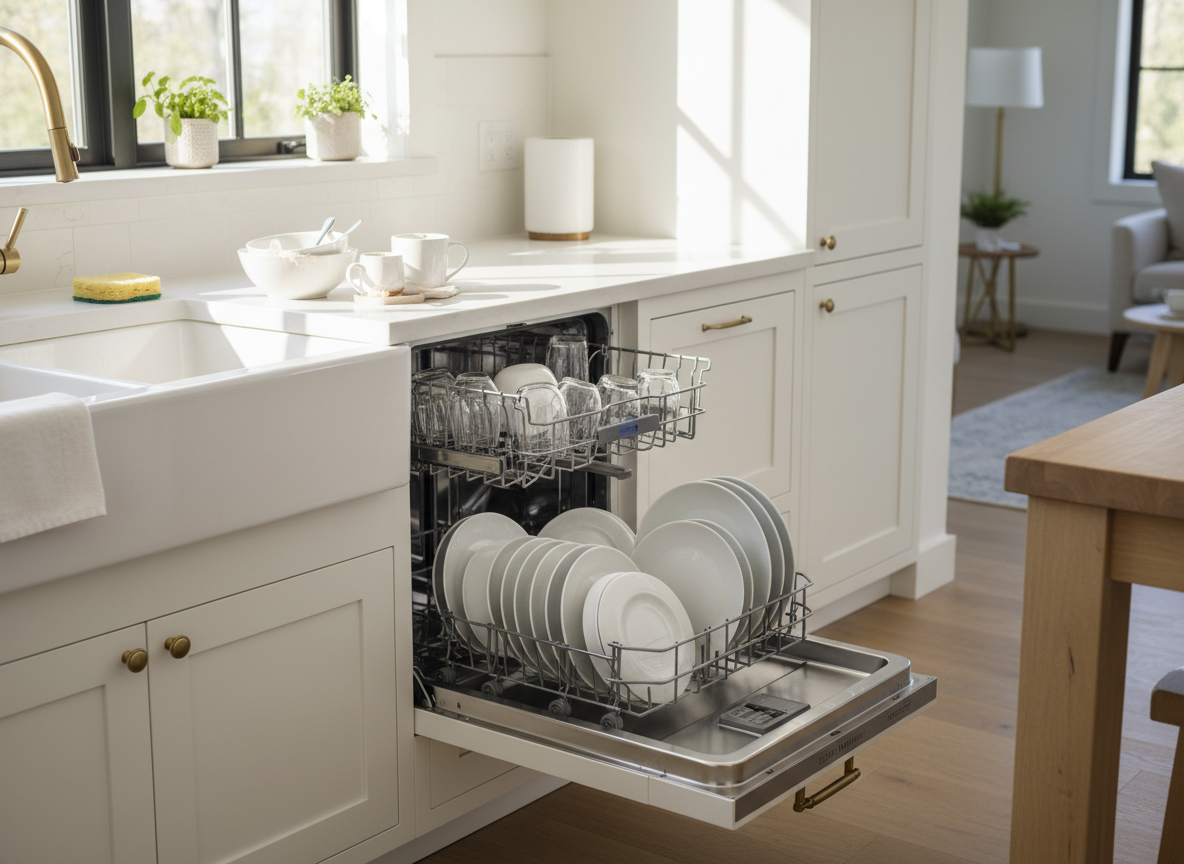
For most US households, running a full, modern dishwasher costs less than washing the same dishes by hand under a running tap — often about 25 cents a load versus roughly 50 to 70 cents. The gap narrows a lot if you hand wash with filled basins instead of a running faucet, and it can flip if you run a half-empty dishwasher or rinse everything first. Here’s the math, using current US prices, so you can see which side of the line your kitchen is on.
Quick answer
| Method (one full load of dishes) | Water used | Typical cost per load* | Per year (5 loads/week) |
|---|---|---|---|
| ENERGY STAR dishwasher, full load | about 3.2 gallons | about $0.25 | about $65 |
| Older dishwasher at the federal limit | up to 5 gallons | about $0.34 | about $87 |
| Hand washing, tap running ~10 min (electric water heater) | about 20 gallons | about $0.71 | about $184 |
| Hand washing, tap running ~10 min (gas water heater) | about 20 gallons | about $0.48 | about $125 |
| Hand washing with two filled basins (electric water heater) | about 8 gallons | about $0.29 | about $75 |
*Includes electricity or gas plus water and sewer at an assumed 1.5¢ per gallon. Assumptions are explained below; your numbers will differ.
Key takeaway: a full dishwasher beats a running tap almost every time. Careful basin washing gets close, but rarely wins once you count your time.
The prices we used
To keep the math honest, every figure in this guide starts from the same inputs:
- Electricity: about 18.2¢ per kWh. That’s the U.S. EIA’s October 2026 forecast for the average residential price this year. Your rate may be well above or below that — check the “price per kWh” line on your electric bill.
- Natural gas: about $1.55 per therm. The EIA forecasts residential gas at roughly $16.09 per thousand cubic feet for 2026, which works out to about $1.55 per therm.
- Water and sewer: 1.5¢ per gallon. Combined water and sewer charges vary hugely by city; many US households pay somewhere around 1 to 2 cents a gallon. Your water bill will show your own rate.
- Hot water: heated from about 50°F to 120°F (10°C to 49°C). Heating one gallon that much takes roughly 0.19 kWh in an electric tank, or about 0.01 therm in a gas tank once typical efficiency losses are included.
What a dishwasher actually uses
Dishwashers sold in the US must meet federal efficiency standards. A standard-size model can use no more than 307 kWh a year and 5 gallons of water per cycle. ENERGY STAR certified models go further: the current specification caps them at 240 kWh a year and 3.2 gallons per cycle.
Those annual ratings assume about 215 loads a year, and they include the energy used to heat the water. So:
- ENERGY STAR model: 240 kWh ÷ 215 loads = about 1.12 kWh per load × $0.182 = about 20¢ in energy, plus 3.2 gallons × 1.5¢ = 5¢ of water. Total: about 25¢ a load.
- Older model at the federal limit: 307 kWh ÷ 215 = about 1.43 kWh × $0.182 = about 26¢, plus 5 gallons × 1.5¢ = 7.5¢. Total: about 34¢ a load.
Modern dishwashers are this frugal because they recirculate a small amount of water, heat it inside the machine, and spray it repeatedly. ENERGY STAR also notes that its certified models cost about $50 a year to run for a standard-size unit.
Your dishwasher’s rated number is on the yellow label
If you’re shopping, the yellow EnergyGuide label shows estimated kWh per year and yearly operating cost. If you already own one, search the model number on the ENERGY STAR product finder or the manufacturer’s site.
What hand washing actually uses
Hand washing is harder to pin down because it depends entirely on your habits. The biggest variable is whether the faucet runs the whole time.
Running tap
New kitchen faucets in the US can flow up to 2.2 gallons per minute. If you leave a faucet running at about 2 gallons a minute for 10 minutes to wash a full load’s worth of dishes, that’s about 20 gallons. If roughly 12 of those gallons are hot:
- Electric water heater: 12 gal × 0.19 kWh = about 2.2 kWh × $0.182 = about 41¢ in energy, plus 20 gal × 1.5¢ = 30¢ of water. Total: about 71¢.
- Gas water heater: 12 gal × 0.01 therm = about 0.12 therm × $1.55 = about 18¢, plus 30¢ of water. Total: about 48¢.
That’s two to three times the cost of a full ENERGY STAR dishwasher load — and it uses more than six times the water.
Two-basin method
If you fill one basin with hot soapy water and one with rinse water (about 8 gallons total, 5 of them hot):
- Electric water heater: 5 gal × 0.19 kWh = about 0.93 kWh × $0.182 = about 17¢, plus 8 gal × 1.5¢ = 12¢ of water. Total: about 29¢.
That’s close to an ENERGY STAR dishwasher and cheaper than an older one. The catch is that most people don’t stick to two basins: they top up with hot water, rinse under the tap, or wash in batches through the day.
ENERGY STAR’s estimate
ENERGY STAR estimates that compared with hand washing, a certified dishwasher can save about 8,400 gallons of water and more than $200 in utility costs a year, plus around 230 hours of your time. Its assumptions aren’t spelled out, and they’re more generous than ours. Our simpler math — five loads a week, a 10-minute running tap — still shows savings of about 4,400 gallons and $60 to $120 a year.
When hand washing can win
A dishwasher isn’t automatically cheaper. Hand washing can come out ahead when:
- You run the dishwasher half full. A dishwasher uses about the same water and energy whether it’s full or half empty. Two half loads cost roughly twice as much as one full load.
- You pre-rinse everything under the tap. Rinsing first adds the running-tap cost on top of the dishwasher cost — the worst of both worlds.
- You live alone and generate very few dishes. If you only have a mug, a plate and a pan a day, washing them in a small basin as you go may beat waiting days to fill a dishwasher.
- Your dishwasher is old. Machines from before the current federal standards can use much more water per cycle than today’s models.
- You use the sanitize or heavy-duty cycle every time. These cycles heat water hotter and run longer.
How to make the dishwasher as cheap as possible
Small habits make a real difference to cost per load:
- Scrape, don’t rinse. ENERGY STAR recommends scraping food scraps into the trash or compost instead of rinsing. Modern detergents and soil sensors are designed for dishes with food on them.
- Wait for a full load. This is the single biggest lever.
- Use the rinse-hold setting if dishes will sit overnight. It uses far less water than rinsing by hand.
- Pick the eco or auto cycle. Eco cycles often run longer but use less energy by working at lower temperatures.
- Turn off heated dry. Let dishes air dry, or open the door a crack at the end of the cycle.
- Run it off-peak if you’re on a time-of-use electricity plan. Most dishwashers have a delay-start button, so you can run them late at night when power is cheapest.
- Check your water heater setting. Many households can set the tank to 120°F; see our guide to the best water heater temperature setting. Check your dishwasher manual first, since some models expect hotter incoming water.
How to make hand washing cheaper
If you don’t have a dishwasher — common in older apartments — you can still keep costs down:
- Use basins or a stoppered sink instead of a running tap.
- Wash in one session rather than a few items at a time throughout the day, so you aren’t reheating water in the pipes again and again.
- Rinse with cool water. Only the wash water needs to be hot.
- Soak pans first instead of scrubbing under hot running water.
- Fit an aerator if your faucet doesn’t have one. It’s a cheap part that lowers flow.
Is it worth buying a dishwasher just to save money?
Usually not on savings alone. A basic dishwasher plus installation often costs several hundred dollars or more. If it saves you around $60 to $120 a year on utilities against running-tap washing, payback could take anywhere from several years to a decade — less if your electricity or water is expensive, more if you were already a careful basin washer.
The stronger case is time. ENERGY STAR’s estimate of around 230 hours a year saved is a lot of evenings back, even if your real figure is lower. For more ways to cut what your appliances cost, see what uses the most electricity at home.
Frequently Asked Questions
Does a dishwasher use more water than washing by hand?
Usually less. An ENERGY STAR dishwasher uses no more than 3.2 gallons per cycle, while a faucet running for 10 minutes can easily use 15 to 20 gallons.
How much does it cost to run a dishwasher once?
At the US average electricity price of about 18.2¢ per kWh, a typical ENERGY STAR dishwasher costs about 20¢ in energy per load, or about 25¢ with water included. Older models cost a bit more.
Is it cheaper to run the dishwasher at night?
Only if you’re on a time-of-use rate, where electricity costs less off-peak. On a flat rate, the cost per kWh is the same at any hour.
Should I rinse dishes before putting them in the dishwasher?
No. Scraping is enough for most modern dishwashers, and rinsing under the tap can add more water and energy than the dishwasher itself uses.
Does a gas water heater change the answer?
It makes hand washing cheaper, because heating water with gas usually costs less than with electricity. But a full dishwasher still typically uses far less water, so it still tends to come out ahead of a running tap.
The bottom line
A full load in a modern dishwasher is usually the cheapest way to clean dishes in a US home — around 25¢ a load versus roughly 50 to 70¢ for washing under a running tap. Careful two-basin washing can come close, but only if you’re disciplined about it. Whichever you use, the rules are the same: wait for a full load, skip the pre-rinse, and keep hot water to a minimum. Savings vary by home, climate and utility rates, so plug your own prices from your bills into the math above.
Sources
- U.S. Energy Information Administration, Short-Term Energy Outlook (October 2026) — residential electricity and natural gas prices
- ENERGY STAR, Dishwashers — operating cost, hand-washing comparison and usage tips
- Appliance Standards Awareness Project, Dishwashers — federal standard and ENERGY STAR Version 7.0 limits
Figures in this guide are estimates based on typical US prices at the time of writing. Savings vary by home, climate and utility rates — check your own bill before making a purchase.
Written by The Daily Economy editorial team with AI assistance and checked against the sources above. Read our editorial policy.