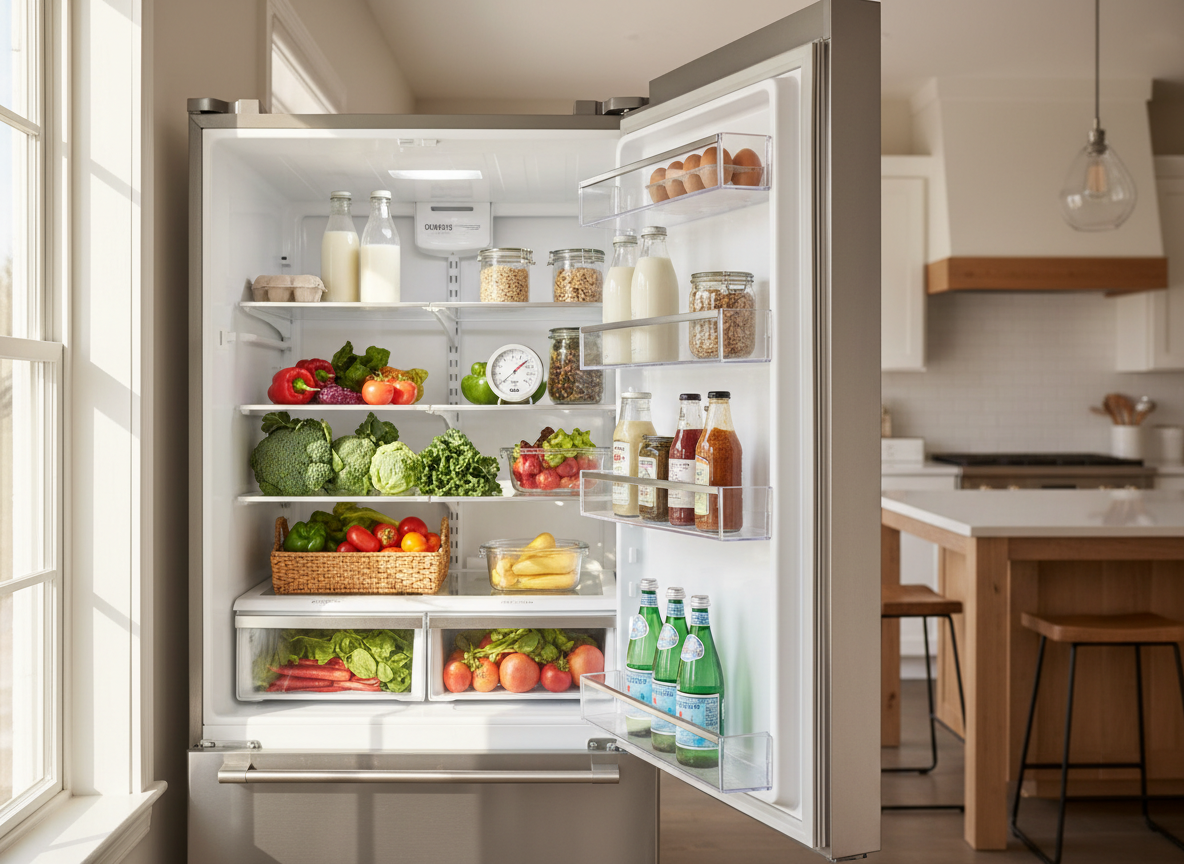
The best refrigerator temperature for most homes is about 37°F (3°C). That sits in the middle of ENERGY STAR’s recommended 35–38°F range and safely below the U.S. Food and Drug Administration’s 40°F limit. Your freezer should be at 0°F (−18°C). Colder than that doesn’t make food meaningfully safer, but it does make your fridge work harder and use more electricity.
Quick answer
| Compartment | Recommended setting | Source / reason |
|---|---|---|
| Refrigerator (target) | ~37°F (3°C) | Middle of ENERGY STAR’s 35–38°F range |
| Refrigerator (safe maximum) | 40°F (4°C) or below | FDA food-safety guidance |
| Freezer | 0°F (−18°C) | FDA food-safety guidance |
| Too cold (fridge) | Below ~33–34°F | Risk of frozen lettuce and milk; extra energy |
| Too warm (fridge) | Above 40°F | Bacteria can grow faster; food spoils sooner |
Savings vary by appliance, climate, home and rates.
Why 37°F is the sweet spot
A refrigerator has two jobs that pull in different directions:
- Keep food safe. The FDA says to keep your refrigerator at 40°F or below and your freezer at 0°F. Above 40°F, bacteria that cause food poisoning can multiply more quickly.
- Use as little energy as possible. The colder you set the fridge, the more often and longer the compressor runs.
ENERGY STAR recommends keeping your refrigerator at 35 to 38°F. Setting it around 37°F gives you a few degrees of buffer below 40°F, because the temperature inside isn’t perfectly even and it rises briefly every time you open the door. Going much colder than 35°F mostly adds cost and can freeze delicate foods near the back.
Your fridge dial probably isn’t telling you the temperature
Many refrigerators have a dial numbered 1–5 or 1–9, or settings like “colder” and “coldest.” Those are not degrees. Even digital displays can differ from the actual temperature on a given shelf.
The FDA notes that few refrigerator controls show the actual temperature and recommends an inexpensive freestanding appliance thermometer, ideally one for the fridge and one for the freezer, and checking them often.
How to check your fridge temperature
- Place a thermometer in the middle of the main compartment, on a middle shelf, not in the door and not touching the back wall.
- Wait several hours, or check first thing in the morning before the door has been opened much.
- Read it. If it’s above 38°F, turn the control slightly colder. If it’s below 35°F, turn it slightly warmer.
- Adjust in small steps and wait about a day between changes so the temperature settles.
- Repeat for the freezer, aiming for 0°F.
Where it’s warmest and coldest
- Door shelves are usually the warmest spot. Good for condiments and drinks, less ideal for milk and eggs.
- The back of lower shelves is often the coldest. Good for raw meat (on the bottom, to avoid drips).
- Crisper drawers hold humidity for produce.
How much does your fridge cost to run?
Refrigerators run all day, every day, so even modest efficiency changes add up over years. To estimate your cost:
Yearly cost = your fridge’s kWh per year × your price per kWh
The kWh figure is on the yellow EnergyGuide label (if you still have it) or in the model’s online specs. According to the U.S. Energy Information Administration (EIA), the average US residential electricity price is roughly 18 cents per kWh in 2026.
Worked examples
| Fridge’s annual use | Math | Yearly cost at ~$0.18/kWh |
|---|---|---|
| 400 kWh | 400 × $0.18 | $72 |
| 500 kWh | 500 × $0.18 | $90 |
| 700 kWh | 700 × $0.18 | $126 |
These label numbers are measured under standard test conditions. Real use varies with room temperature, how full the fridge is, how often it’s opened and, yes, the temperature setting.
How much does the temperature setting change the cost?
There’s no single reliable “percent per degree” figure that applies to every refrigerator, so be wary of anyone who quotes one confidently. What’s certain is the direction: a colder setting means more compressor run time and more electricity. If your thermometer shows your fridge is at 33°F and your freezer is at −10°F, you’re paying extra for cold you don’t need. Nudging both back to 37°F and 0°F costs nothing and removes that waste.
Other ways to cut refrigerator energy use
Temperature is only one piece. These habits often matter just as much:
- Clean the condenser coils. Dusty coils (behind or under the fridge) make the compressor work harder. Unplug the fridge and vacuum them once or twice a year, following your manual.
- Check the door seals. Close the door on a sheet of paper or a dollar bill. If it slides out easily, the gasket may be leaking cold air. Clean it, and replace it if it’s torn.
- Leave space around the fridge for air to flow, per the manufacturer’s clearance guidance.
- Keep it away from heat. Direct sun, an oven or a heating vent next to the fridge increases its workload.
- Don’t cram it full. Cold air needs to circulate. A reasonably full fridge is fine; a packed one can create warm spots.
- Close the door promptly. Decide what you want before opening it.
- Cover liquids and foods to reduce moisture inside.
- Turn off “power cool” or “fast freeze” modes after they’ve done their job.
- Defrost manual-defrost freezers before frost builds up thickly.
A food-safety note: don’t leave hot leftovers on the counter to “save the fridge.” Food-safety guidance is to refrigerate perishables promptly. Divide large portions into shallow containers so they chill quickly.
Is your old or second fridge costing you?
ENERGY STAR says that, on average, an old refrigerator uses about 20% more energy than a model that has earned the ENERGY STAR label, and certified models are about 9% more efficient than the federal minimum standard. ENERGY STAR also estimates that recycling an old refrigerator and replacing it with a certified model can save about $150 over the product’s 12-year lifetime.
The bigger win is often the second fridge in the garage or basement. If it’s old, rarely used or half empty, unplugging it (and recycling it properly) removes a full appliance’s worth of running cost. Garages can also get very hot or cold, which makes an older fridge struggle. If you do need a second fridge year-round, ENERGY STAR recommends choosing a certified one.
Wondering whether unplugging other things helps too? See does unplugging appliances save money, and for a ranking of the biggest energy users, read what uses the most electricity at home.
What to do during a power outage
The USDA advises keeping the refrigerator and freezer doors closed as much as possible during an outage. A closed refrigerator keeps food safe for about 4 hours; a full freezer holds its temperature for about 48 hours (about 24 hours if half full). When the power returns, check your thermometer: perishable food that has been above 40°F for more than 2 hours should be thrown out. When in doubt, throw it out.
Frequently Asked Questions
What is the best temperature for a refrigerator?
About 37°F (3°C). It’s within ENERGY STAR’s 35–38°F recommendation and safely below the FDA’s 40°F maximum.
What temperature should my freezer be?
0°F (−18°C), per FDA guidance. Setting it much colder uses more energy without a meaningful food-safety benefit for home storage.
Is 40°F too warm for a fridge?
40°F is the upper safe limit. Because the temperature fluctuates when you open the door, aiming a few degrees lower, around 37°F, gives you a safety margin.
What number should my fridge dial be on?
It depends on the model; the numbers aren’t degrees. Start in the middle setting, measure with an appliance thermometer, and adjust until it reads 35–38°F.
Does a colder fridge use more electricity?
Yes. The colder the setting, the more the compressor runs. The exact effect varies by model and conditions, but keeping the fridge colder than needed wastes energy.
The bottom line
Set your refrigerator to about 37°F and your freezer to 0°F, and check both with a cheap appliance thermometer rather than trusting the dial. That keeps food safely below the FDA’s 40°F limit without paying to chill it more than necessary. Add clean coils, tight door seals and a hard look at that old garage fridge, and you’ll trim a steady, year-round cost from your bill. Savings vary by appliance, climate, home and rates.
Figures in this guide are estimates based on typical US prices at the time of writing. Savings vary by home, climate and utility rates — check your own bill before making a purchase.
