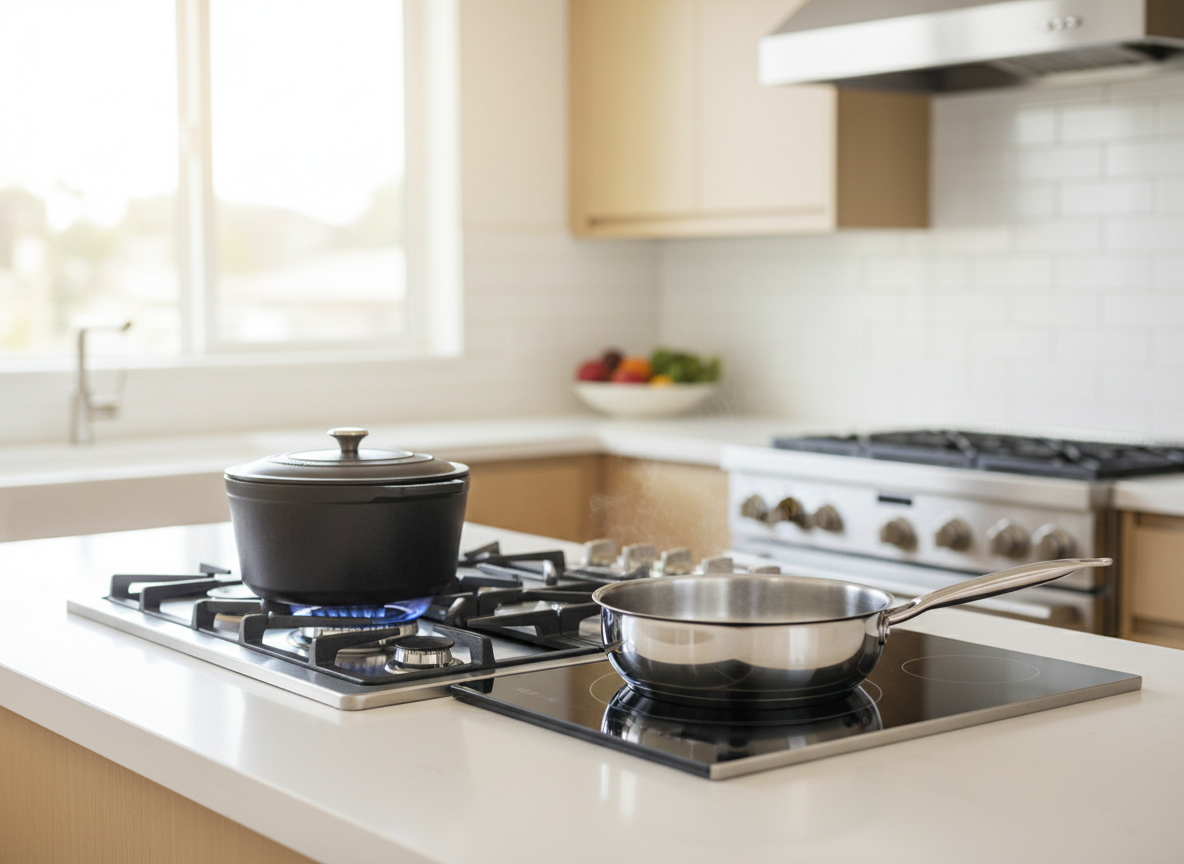
At U.S. average prices, cooking on a gas stove is usually a little cheaper to run than an electric coil or smooth-top — but the gap is small — about $20–$30 a year in our example below — because a stove uses far less energy than heating, cooling or water heating. Induction narrows the gap further, and where electricity is cheap (or gas is expensive) electric can win. The bigger money questions are usually the purchase price, installation, and whether keeping a gas hookup for just a stove is worth its monthly fixed charge.
Quick answer
| Gas | Electric (coil / smooth-top) | Induction | |
|---|---|---|---|
| Cooktop efficiency (ENERGY STAR) | ~32% | ~75–80% | ~85% |
| Energy price used here | $1.50/therm | $0.18/kWh | $0.18/kWh |
| Cost for the same cooking, example household | ~$68/year | ~$99/year | ~$90/year |
| Upfront cost | Moderate; needs gas line | Usually lowest | Higher; may need new cookware |
| Indoor air | Combustion byproducts — ventilate | No combustion | No combustion |
Example assumes cooking equal to 1.5 kWh of electric-element use per day. Your numbers will differ — the method below shows how to work them out.
The prices behind the math
- Electricity: about $0.18 per kWh. The U.S. EIA reported an average residential price of 18.3¢/kWh for July 2026, and its short-term outlook puts the 2026 average near 18.2¢.
- Natural gas: the U.S. EIA’s 2025 residential average was $15.40 per thousand cubic feet (Mcf). One Mcf holds roughly 10.37 therms, so that’s about $1.49 per therm — we round to $1.50.
One caution on gas: EIA’s monthly residential gas prices look much higher in summer (over $24/Mcf in June 2026) than in winter. That’s partly because fixed customer charges are spread over much less gas when nobody’s heating. The annual average is a better guide for year-round cooking costs.
Your own rates can be very different from these averages — check your bills (see how to read your electric bill).
Why efficiency matters so much for stoves
ENERGY STAR estimates that:
- Gas cooktops are about 32% efficient — most of the flame’s heat goes around the pan into the kitchen.
- Electric resistance (coil and radiant smooth-top) is about 75–80% efficient.
- Induction is about 85% efficient, because it heats the pan directly.
So although gas energy is cheaper per unit than electricity, gas stoves waste more of it. Here’s the comparison per unit of heat that actually reaches the food.
Cost per 100,000 BTU of useful heat
- Gas: 1 therm = 100,000 BTU. At 32% efficiency, you need 1 ÷ 0.32 = 3.125 therms × $1.50 = $4.69
- Electric resistance: 1 kWh = 3,412 BTU. At 77.5% efficiency: 100,000 ÷ (3,412 × 0.775) = 37.8 kWh × $0.18 = $6.81
- Induction: at 85%: 100,000 ÷ (3,412 × 0.85) = 34.5 kWh × $0.18 = $6.21
Key takeaway: at national average prices, gas delivers cooking heat for roughly 25–30% less than electric. But because cooking uses little energy overall, that percentage translates into modest dollars.
Annual cost example
Let’s take a household whose stovetop cooking equals 1.5 kWh a day on an electric element — for instance, a 1,500 W burner used for an hour, or a bigger burner for less time.
| Stove type | Energy per year | Cost per year |
|---|---|---|
| Electric resistance | 1.5 kWh × 365 = 547.5 kWh | 547.5 × $0.18 = $98.55 |
| Induction (same heat to food) | ≈ 499 kWh | 499 × $0.18 = $89.85 |
| Gas (same heat to food) | ≈ 45.2 therms | 45.2 × $1.50 = $67.86 |
How the gas figure works: 1.5 kWh × 77.5% efficiency × 3,412 BTU = about 3,970 BTU of useful heat a day. Divide by 32% gas efficiency = about 12,400 BTU of gas a day, or 0.124 therms. × 365 days = 45.2 therms.
In this example, gas saves about $31 a year vs. a coil or smooth-top, and about $22 a year vs. induction. Cook more, and the gap grows; cook less, and it shrinks.
When electric wins instead
Prices vary enormously by state and utility. Using the same example household:
| Electricity price | Gas price | Electric | Induction | Gas |
|---|---|---|---|---|
| $0.13/kWh | $1.50/therm | $71 | $65 | $68 |
| $0.18/kWh | $1.50/therm | $99 | $90 | $68 |
| $0.30/kWh | $1.50/therm | $164 | $150 | $68 |
| $0.18/kWh | $2.20/therm | $99 | $90 | $100 |
| $0.18/kWh | $1.10/therm | $99 | $90 | $50 |
Rule of thumb: with gas at $1.50 per therm, induction becomes cheaper to run than gas when electricity drops below roughly 13.6¢ per kWh ($1.50 × 3.125 ÷ 34.5 kWh). If you have time-of-use rates, cooking at off-peak times can also tip the math.
Per-hour cost of a single burner
Burner ratings give a quick sense of hourly cost at full power (real cooking often runs lower):
- Electric element, 2,000 W: 2 kWh × $0.18 = $0.36 per hour
- Gas burner, 9,000 BTU/h: 0.09 therm × $1.50 = $0.135 per hour
Remember the gas burner delivers much less of that heat to the pan, which is why the fair comparison is the “useful heat” math above.
What about the oven?
The same logic applies: multiply the oven’s wattage (or BTU rating) by hours of use and your price. Ovens cycle on and off to hold temperature, so actual use is below the rating. Small appliances — air fryers, toaster ovens, microwaves, electric kettles — often use less energy than heating a full-size oven for small meals.
The hidden cost: the gas hookup
If your stove is the only gas appliance in your home, look at your gas bill’s fixed monthly customer charge. You pay it whether you cook or not, and over a year it can easily exceed the whole energy cost of cooking. Switching to electric and closing the gas account removes that charge. If gas already heats your home and water, the stove adds only its usage cost.
Upfront and switching costs
- Electric coil/smooth-top ranges are usually the cheapest to buy.
- Induction ranges cost more; the U.S. Department of Energy has noted that four-burner induction ranges can run around $1,000, and single-burner portable units much less.
- Induction needs magnetic cookware (cast iron and many stainless pans work; aluminum, copper and glass usually don’t unless marked induction-ready).
- Switching from gas may need a 240-volt outlet and circuit, which can mean electrician costs, and capping the gas line.
- Switching to gas requires a gas line to the kitchen — often impractical if the home has no gas service.
Incentives: there’s no general federal tax credit for a stove. Some states run rebate programs for induction and electrical upgrades, but availability and eligibility vary — check your state energy office and utility before buying.
Beyond the bill: cooking and indoor air
- Speed: DOE notes induction can boil water faster than gas and conventional electric cooktops.
- Control: gas and induction both respond instantly; coil and radiant tops are slower to change heat.
- Air quality: the U.S. Department of Energy notes that gas stoves produce combustion byproducts such as nitrogen oxides and carbon monoxide. Whatever you cook on, use a range hood vented outdoors, or open a window.
- Heat in summer: because gas wastes more heat into the room, it can make your AC work slightly harder in hot weather.
For a broader look at where your home’s energy goes, see what uses the most electricity at home.
Frequently Asked Questions
Is it cheaper to cook with gas or electric?
At U.S. average prices, gas is usually slightly cheaper to run — in our example about $68 vs. $99 a year. Where electricity is cheap or gas is expensive, electric (especially induction) can be cheaper.
Is induction cheaper to run than gas?
Only when electricity is cheap relative to gas. With gas at $1.50/therm, induction wins below roughly 13.6¢/kWh. At 18¢/kWh, gas is a bit cheaper.
Should I replace a working gas stove to save money?
Rarely for running costs alone — the yearly difference is small compared with the price of a new range. It can make sense if the stove is your only gas appliance (removing a fixed monthly charge), the old one is failing, or you want induction for other reasons.
How much does it cost to run an electric stove per hour?
Multiply the burner’s watts by hours and your rate. A 2,000 W element at full power for one hour costs about $0.36 at $0.18/kWh.
Do gas stoves have a standing pilot light?
Most modern gas ranges use electronic ignition. Some older models have standing pilots, which burn gas continuously — worth checking if yours is old.
The bottom line
Gas vs electric stove cost comes down to your local prices and how much you cook, but for most households the running-cost difference is tens of dollars a year, not hundreds. Gas is usually a little cheaper per meal at average U.S. prices; induction is the most efficient and wins where electricity is cheap. Weigh purchase, installation, fixed gas charges and indoor air alongside the energy bill — savings vary by climate, home and rates.
Figures in this guide are estimates based on typical US prices at the time of writing. Savings vary by home, climate and utility rates — check your own bill before making a purchase.
