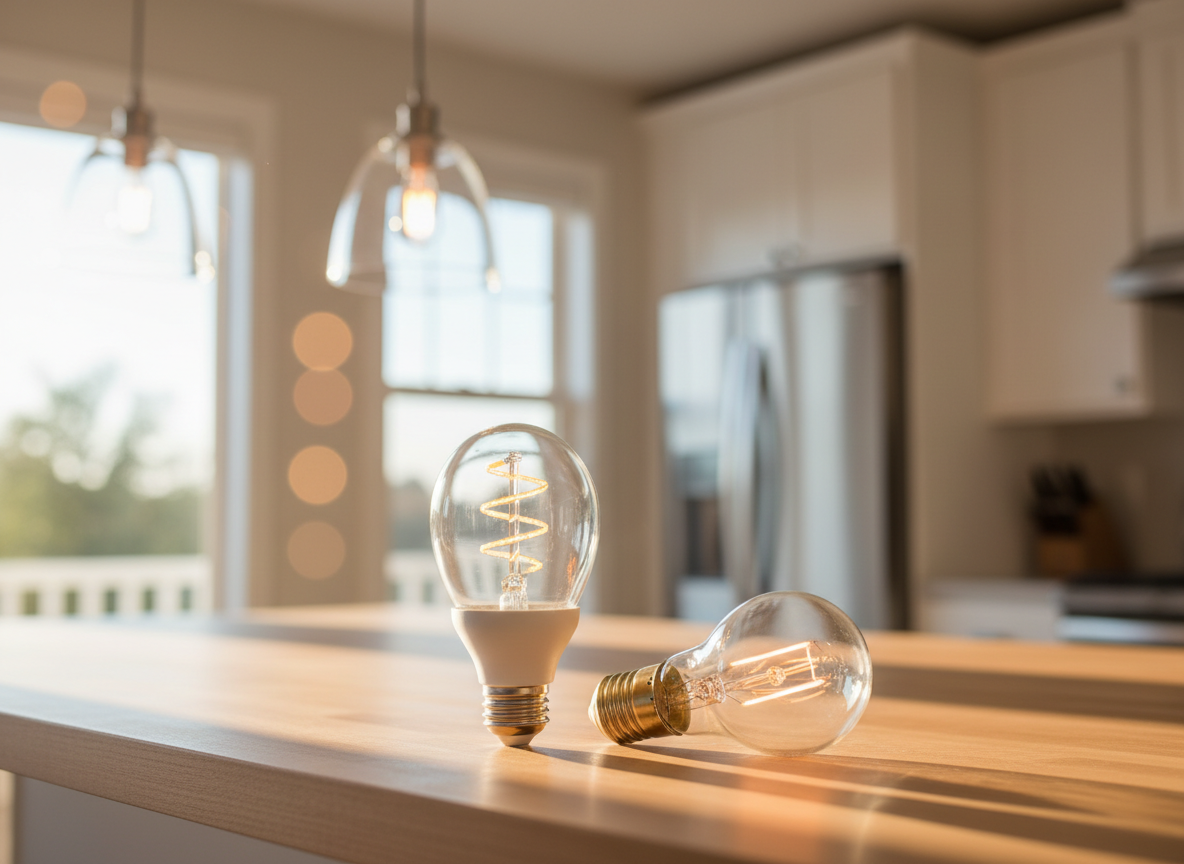
Switching one 60-watt incandescent bulb to a 9-watt LED saves about $10 a year if the light is on 3 hours a day, at today’s average electricity price. The LED typically pays for itself in a few months and can last well over a decade. Across a whole house of older bulbs, the savings can reach a couple of hundred dollars a year, though many homes have already switched most of their lights.
Quick answer: LED vs incandescent at a glance
Costs use about $0.18 per kWh, roughly the US average residential price in mid-2026 according to the U.S. EIA, and assume the bulb is on 3 hours a day.
| 60 W incandescent | 43 W halogen | 9 W LED | |
|---|---|---|---|
| Light output | About 800 lumens | About 750-800 lumens | About 800 lumens |
| Energy per year | 65.7 kWh | 47.1 kWh | 9.9 kWh |
| Electricity cost per year | $11.83 | $8.47 | $1.77 |
| Typical lifespan | About 1,000 hours | About 1,000-2,000 hours | About 15,000-25,000 hours |
| Years of life at 3 h/day | Under 1 year | 1-2 years | About 14-23 years |
| Heat given off | A lot | A lot | Very little |
Key takeaways:
- About $10 saved per bulb per year when replacing a 60 W incandescent used 3 hours a day.
- Payback is fast: a $2-$4 LED usually pays for itself in 2-5 months of normal use.
- The more hours a light is on, the more you save. Start with your most-used fixtures.
The math, step by step
Here’s how the per-bulb numbers above are calculated, so you can plug in your own rate and hours.
Incandescent (60 W):
- 60 W × 3 hours × 365 days = 65,700 Wh = 65.7 kWh a year
- 65.7 kWh × $0.18 = $11.83 a year
LED (9 W):
- 9 W × 3 hours × 365 days = 9,855 Wh = 9.9 kWh a year
- 9.9 kWh × $0.18 = $1.77 a year
Savings: $11.83 − $1.77 = about $10 per bulb per year.
Payback on a $3 LED: $3 ÷ $10 a year = about 0.3 years, or roughly 4 months.
The U.S. Department of Energy says residential LEDs, especially ENERGY STAR rated ones, use at least 75% less energy and last up to 25 times longer than incandescent lighting. Our 60 W vs 9 W example is actually an 85% reduction.
Savings over the life of one LED
A good LED rated for 25,000 hours replaces about 25 incandescent bulbs over its life.
- Incandescent electricity: 25,000 h × 0.060 kW = 1,500 kWh × $0.18 = $270
- LED electricity: 25,000 h × 0.009 kW = 225 kWh × $0.18 = $40.50
- Electricity saved: about $230 per socket, before counting the 24 or so replacement bulbs you don’t have to buy.
Real-world lifespans vary. Heat, enclosed fixtures, frequent switching and cheap electronics can shorten an LED’s life.
How much can a whole house save?
It depends on how many old bulbs you still have and how long they’re on.
| Scenario | Bulbs switched | Hours per day | Estimated yearly savings |
|---|---|---|---|
| A few leftover bulbs | 5 | 3 | About $50 |
| Partly upgraded home | 12 | 3 | About $120 |
| Home with mostly old bulbs | 20 | 3 | About $200 |
| High-use rooms (kitchen, living room) | 6 | 6 | About $120 |
Each row uses about $10 per bulb per year at 3 hours a day (double that at 6 hours). If your home is already mostly LED, the remaining savings will be small, and your time is better spent on bigger loads. See what uses the most electricity at home for where the real money goes.
Bonus savings in summer
Incandescent bulbs turn most of their energy into heat rather than light. In summer, your air conditioner has to remove that extra heat. LEDs run much cooler, which trims cooling costs slightly. (In winter, the lost heat from old bulbs helped a little, but it’s an expensive way to heat a home.)
Can you still buy incandescent bulbs?
For most common household bulbs, not really. A U.S. Department of Energy efficiency standard for general-service lamps, fully enforced since August 2023, requires at least 45 lumens per watt. Standard incandescent and most halogen bulbs can’t meet that, so stores have largely stopped selling them for everyday use. Some specialty bulbs, like appliance bulbs, certain decorative types and some colored bulbs, are treated differently.
So the question for most people isn’t whether to switch, but how to replace the old bulbs you still have in drawers and fixtures.
How to choose the right LED
Shopping by watts no longer works, because LEDs use so few of them. Use these instead:
Match the lumens (brightness)
| Old incandescent | LED brightness to look for | Typical LED watts |
|---|---|---|
| 40 W | About 450 lumens | 5-6 W |
| 60 W | About 800 lumens | 8-10 W |
| 75 W | About 1,100 lumens | 11-13 W |
| 100 W | About 1,600 lumens | 14-17 W |
Pick the color temperature
- 2,700K (warm white): closest to the old incandescent glow. Good for living rooms and bedrooms.
- 3,000K (soft white): slightly crisper. Good for kitchens and bathrooms.
- 4,000-5,000K (cool white/daylight): bright and blue-ish. Good for garages, workspaces and reading.
Check the details
- Dimmable: if the bulb goes on a dimmer switch, buy one labeled dimmable. Older dimmers may flicker or buzz with LEDs; an LED-compatible dimmer usually fixes it.
- Enclosed fixtures: for closed glass globes, pick bulbs rated for enclosed fixtures to avoid overheating.
- ENERGY STAR label: certified bulbs are tested for brightness, color and lifespan claims.
- Color rendering (CRI): 90 or higher makes skin tones and food look more natural.
Where to start switching
You’ll get the fastest payback by replacing bulbs in this order:
- Lights on the most hours: kitchen, living room, porch lights, security lights.
- Outdoor lights on all night: a 60 W porch light on 12 hours a day costs about $47 a year as an incandescent vs about $7 as an LED.
- High-wattage bulbs: old 75 W and 100 W bulbs and halogen floodlights.
- Rarely used lights (closets, guest rooms): replace these last, or when the old bulb burns out.
Tip: pair LEDs with motion sensors or timers on outdoor and garage lights for extra savings.
What about CFLs?
Compact fluorescent lamps (CFLs) were the step between incandescents and LEDs. A 13-14 W CFL gives about the same light as a 60 W incandescent, so it’s already efficient. Switching a working CFL to a 9 W LED saves only about $1 a year at 3 hours a day (5 W × 3 h × 365 = 5.5 kWh × $0.18), so it’s fine to replace them as they burn out. CFLs contain a small amount of mercury, so recycle them rather than throwing them in the trash; many hardware stores and local waste programs accept them.
Frequently Asked Questions
How much money do LED bulbs save per year?
About $10 per bulb per year when replacing a 60 W incandescent used 3 hours a day at $0.18/kWh. Savings rise with more hours of use and higher electricity rates.
Do LED bulbs really last 20 years?
Many are rated for 15,000-25,000 hours, which works out to roughly 14-23 years at 3 hours a day. Actual life depends on heat, fixture type and bulb quality.
Is it worth replacing incandescent bulbs that still work?
Usually yes, especially in fixtures you use often. At about $10 a year in savings, a $3 LED pays for itself in a few months.
Do LED lights use less electricity when dimmed?
Yes, dimmable LEDs generally use less power when dimmed, though not always in exact proportion to the brightness.
Is it bad to turn LED lights on and off frequently?
No. Unlike some CFLs, LEDs handle frequent switching well. Turning lights off when you leave a room always saves energy.
The bottom line
LEDs save about $10 a year per bulb compared with a 60 W incandescent, pay for themselves in months and last many years. If you still have old bulbs in high-use fixtures, swapping them is one of the easiest wins in your home. Savings vary by rates and habits, and once your lighting is done, bigger gains come from heating, cooling and hot water. Our guide on how to lower your electric bill shows what to tackle next, and does unplugging appliances save money covers another quick fix.
Figures in this guide are estimates based on typical US prices at the time of writing. Savings vary by home, climate and utility rates — check your own bill before making a purchase.
