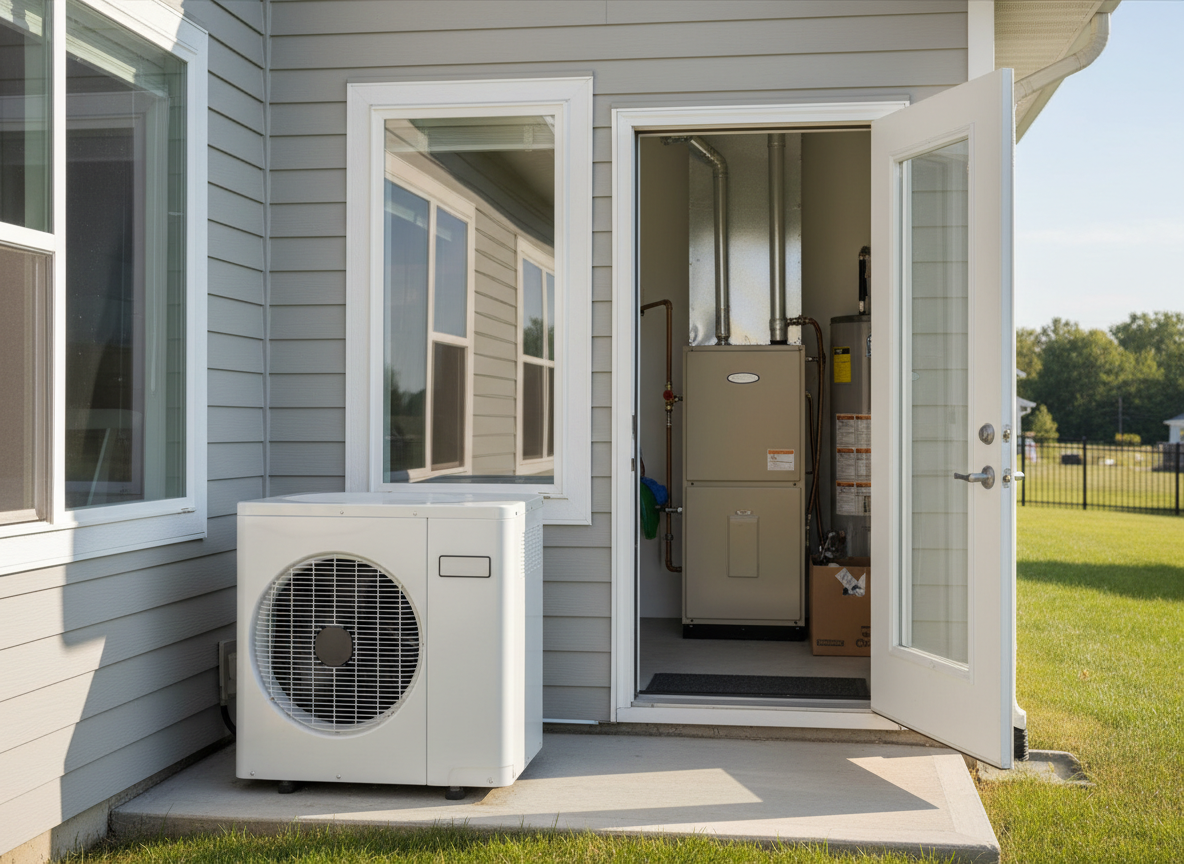
Whether a heat pump or a gas furnace is cheaper to run depends almost entirely on two numbers: your electricity price per kWh and your natural gas price per therm, plus how efficient each system is. At today’s US average prices, a high-efficiency gas furnace and a good heat pump come out surprisingly close, with gas often slightly cheaper in cold climates. But against propane, heating oil or electric baseboard, a heat pump usually wins clearly. Below is the math, step by step, so you can plug in your own rates.
Quick answer
| Heating system | Efficiency | Cost per million Btu of heat delivered* |
|---|---|---|
| Gas furnace, high efficiency | 95% AFUE | ~$14.74 |
| Gas furnace, older | 80% AFUE | ~$17.50 |
| Heat pump, very efficient/mild climate | COP 3.5 | ~$15.07 |
| Heat pump, typical | COP 3.0 | ~$17.58 |
| Heat pump, cold climate average | COP 2.5 | ~$21.10 |
| Electric baseboard / furnace | COP 1.0 | ~$52.75 |
Assumes $1.40 per therm of natural gas and $0.18 per kWh* of electricity. Your prices will change the ranking, so use the formula later in this article.
The prices behind the math
According to the U.S. EIA, the average US residential electricity price was a little over 18 cents per kWh in mid-2026, and EIA’s September 2026 Short-Term Energy Outlook projects about 18.2 cents for the full year. EIA data put the average residential natural gas price at about $15.34 per thousand cubic feet in 2025. One thousand cubic feet contains a little over 10 therms, so that’s roughly $1.48 per therm on an annual basis; winter-month prices per unit are often lower (January 2026 averaged about $13.96 per thousand cubic feet, or roughly $1.35 per therm). We use $1.40 per therm as a middle figure.
EIA also expects wholesale natural gas prices to rise in 2027 as new export terminals ramp up, so the comparison could shift over the life of a system. Prices vary a lot by state and utility, so look at your own bill. Our guide on how to read your electric bill shows where to find your true price per kWh, including delivery charges.
The key efficiency terms, in plain English
AFUE (furnaces)
Annual Fuel Utilization Efficiency is the share of the fuel’s energy that ends up as heat in your home over a season. A 95% AFUE furnace turns 95 cents of every gas dollar into heat; 5 cents goes up the flue. Older furnaces are often around 80% or lower.
COP (heat pumps)
Coefficient of Performance is heat delivered divided by electricity used. A heat pump doesn’t make heat by burning anything; it moves heat from outdoors to indoors. With a COP of 3, it delivers 3 units of heat for every 1 unit of electricity. COP drops as the outdoor temperature falls, so what matters for your bill is the seasonal average COP, not the best-case number.
HSPF2 (heat pump labels)
Heat pumps sold in the US are rated with HSPF2, a seasonal heating efficiency in Btu per watt-hour. Dividing HSPF2 by 3.412 gives a rough seasonal COP. For example, an HSPF2 of 8.5 ÷ 3.412 ≈ COP 2.5. Real-world performance depends on your climate, installation and ductwork.
The units
- 1 therm = 100,000 Btu
- 1 kWh = 3,412 Btu
- 1 million Btu (MMBtu) = 10 therms = about 293 kWh
Worked examples: cost per million Btu delivered
We compare systems by the cost to put 1 million Btu of heat into your home.
Gas furnace
Cost = (10 therms ÷ AFUE) × price per therm
- 95% AFUE: 10 ÷ 0.95 = 10.53 therms × $1.40 = $14.74
- 80% AFUE: 10 ÷ 0.80 = 12.5 therms × $1.40 = $17.50
Heat pump
Cost = (293 kWh ÷ COP) × price per kWh
- COP 3.5: 293 ÷ 3.5 = 83.7 kWh × $0.18 = $15.07
- COP 3.0: 293 ÷ 3.0 = 97.7 kWh × $0.18 = $17.58
- COP 2.5: 293 ÷ 2.5 = 117.2 kWh × $0.18 = $21.10
Electric resistance (baseboard, electric furnace)
- COP 1.0: 293 kWh × $0.18 = $52.75
A heat pump running at COP 2.5 heats for about 60% less than baseboard heat at the same electricity price.
A full-season example
Say your home needs 50 million Btu of delivered heat over a winter (a plausible figure for a moderately sized house in a cold-ish climate; yours could be much higher or lower).
| System | Math | Season cost |
|---|---|---|
| 95% gas furnace | 50 × $14.74 | ~$737 |
| 80% gas furnace | 50 × $17.50 | ~$875 |
| Heat pump, COP 3.0 | 50 × $17.58 | ~$879 |
| Heat pump, COP 2.5 | 50 × $21.10 | ~$1,055 |
| Electric baseboard | 50 × $52.75 | ~$2,638 |
At national-average prices, replacing an older 80% furnace with a typical heat pump is roughly a wash on heating, while a new 95% furnace is cheaper to run than a heat pump averaging COP 2.5–3. Replacing electric baseboard with a heat pump could save well over $1,500 a year in this example.
What if your prices are different?
Change the rates and the answer changes:
- Cheap electricity (12 cents/kWh), COP 3: 97.7 kWh × $0.12 = $11.72 per MMBtu → ~$586 a season, beating even a 95% furnace at $1.40 gas.
- Expensive gas ($2.00/therm), 95% furnace: 10.53 × $2.00 = $21.05 per MMBtu → ~$1,053 a season, more than a COP 3 heat pump at 18 cents.
The break-even formula
To find the electricity price at which a heat pump costs the same as your furnace:
Break-even $/kWh = gas $/therm × COP ÷ (29.3 × AFUE)
(29.3 is the number of kWh in one therm.)
Example: $1.40 × 3.0 ÷ (29.3 × 0.95) = 4.20 ÷ 27.8 = $0.151 per kWh.
So with $1.40 gas, a 95% furnace, and a heat pump averaging COP 3, the heat pump is cheaper to run if you pay less than about 15 cents per kWh. Against an 80% furnace, the break-even rises to about 17.9 cents.
Using propane or heating oil? Run the same comparison with your fuel’s cost per million Btu: propane has about 91,500 Btu per gallon and heating oil about 138,500 Btu per gallon. Because these fuels are usually priced higher per Btu than utility gas, heat pumps often come out ahead.
Don’t forget cooling
A heat pump is also a central air conditioner. If you’d be buying or replacing an AC anyway, the heat pump’s extra cost is often modest, and a new heat pump may cool more efficiently than an aging AC. A furnace, on the other hand, only heats.
Other factors beyond operating cost
- Climate: modern cold-climate heat pumps can keep heating well below freezing, but their COP falls as it gets colder. Many cold-climate homes keep a furnace as backup (“dual fuel”).
- Time-of-use rates: if your electricity price changes by hour, heat pump costs depend on when it runs. See time-of-use electricity rates explained.
- Fixed gas charges: if a heat pump lets you drop gas service entirely, you also stop paying the monthly customer charge.
- Installation quality and ductwork: poor sizing or leaky ducts can erase the efficiency on the label.
- Incentives: the federal 25C credit that covered heat pumps (up to $2,000) ended for property placed in service after December 31, 2025, under the 2025 federal budget law, so it isn’t available for 2026 installs. Some states and utilities still offer heat pump rebates; check with your utility and state energy office.
Frequently Asked Questions
Is a heat pump cheaper to run than a gas furnace?
It depends on your rates. At roughly 18 cents per kWh and $1.40 per therm, a high-efficiency gas furnace is often slightly cheaper for heating. With cheaper electricity or pricier gas, the heat pump usually wins.
Is a heat pump cheaper than electric baseboard heat?
Almost always. Even at a seasonal COP of 2, a heat pump uses about half the electricity of resistance heating for the same warmth.
What COP should I assume for my heat pump?
For rough planning, a seasonal COP of 2.5–3 is reasonable for many climates, higher in mild areas and lower in very cold ones. Dividing the unit’s HSPF2 rating by 3.412 gives a conservative estimate.
Do heat pumps work in cold weather?
Yes. Cold-climate models are designed to keep heating in sub-freezing weather, though efficiency drops and backup heat may run on the coldest days.
Can I still get a federal tax credit for a heat pump?
Not for installs in 2026. The 25C credit ended for property placed in service after December 31, 2025. Look for state or utility rebates instead.
The bottom line
The heat pump vs furnace cost question comes down to your local prices and each system’s real-world efficiency. At national-average rates, a modern gas furnace and a good heat pump are close, gas has a slight edge in colder climates, and heat pumps win clearly against propane, oil and electric resistance heat. Plug your own $/therm, $/kWh, AFUE and COP into the break-even formula above before you decide. Savings vary by climate, home and rates.
Figures in this guide are estimates based on typical US prices at the time of writing. Savings vary by home, climate and utility rates — check your own bill before making a purchase.
